
Mouse Six3 activation kit by CRISPRa
$1,657.00
4 Weeks*
Specifications
| Product Data | |
| Format | 3 gRNAs (5ug each), 1 scramble ctrl (10ug) and 1 enhancer vector (10ug) |
|---|---|
| Target Symbol | Six3 |
| Locus ID | 20473 |
| Components |
GA203914G1, Six3 gRNA vector 1 in pCas-Guide-GFP-CRISPRa GA203914G2, Six3 gRNA vector 2 in pCas-Guide-GFP-CRISPRa GA203914G3, Six3 gRNA vector 3 in pCas-Guide-GFP-CRISPRa 1 CRISPRa-Enhancer vector, SKU GE100056 1 CRISPRa scramble vector, SKU GE100077 |
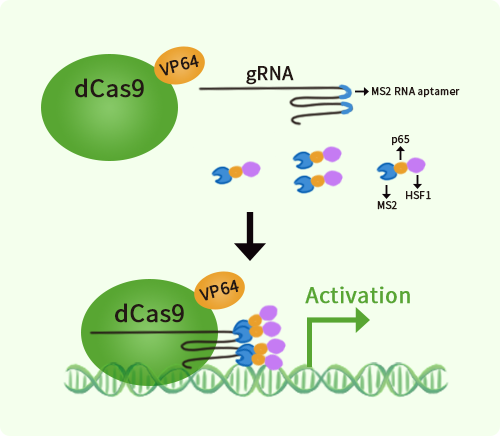
| OTI Disclaimer | These products are manufactured and supplied by OriGene under license from ERS. The kit is designed based on the best knowledge of CRISPRa SAM technology. The efficiency of the activation can be affected by many factors, including nucleosome occupancy status, chromatin structure and the gene expression level of the target, etc. |
| Shipping | Ambient |
| Reference Data | |
| RefSeq | NM_011381 |
| UniProt ID | Q62233 |
| Synonyms | E130112M24Rik; Six3a; Six3alpha; Six3b; Six3beta |
| Summary | Transcriptional regulator which can act as both a transcriptional repressor and activator by binding a ATTA homeodomain core recognition sequence on these target genes. During forebrain development represses WNT1 expression allowing zona limitans intrathalamica formation and thereby ensuring proper anterio-posterior patterning of the diencephalon and formation of the rostral diencephalon (PubMed:18094027). Acts as a direct upstream activator of SHH expression in the rostral diencephalon ventral midline and that in turn SHH maintains its expression (PubMed:18775421). In addition, Six3 activity is required for the formation of the telencephalon. During postnatal stages of brain development is necessary for ependymal cell maturation by promoting the maturation of radial glia into ependymal cells through regulation of neuroblast proliferation and migration (PubMed:22071110). Acts on the proliferation and differentiation of neural progenitor cells through activating transcription of CCND1 AND CCND2 (PubMed:17576749). During early lens formation plays a role in lens induction and specification by activating directly PAX6 in the presumptive lens ectoderm (PubMed:17066077). In turn PAX6 activates SIX3 resulting in activation of PDGFRA and CCND1 promoting cell proliferation (PubMed:12072567). Also is required for the neuroretina development by directly suppressing WNT8B expression in the anterior neural plate territory (PubMed:20890044). Its action during retina development and lens morphogenesis is TLE5 and TLE4-dependent manner. Furthermore, during eye development regulates several genes expression. Before and during early lens development represses the CRYGF promoter by binding a SIX repressor element (PubMed:11139622). Directly activates RHO transcription, or cooperates with CRX or NRL (PubMed:17666527). Six3 functions also in the formation of the proximodistal axis of the optic cup (PubMed:12163408), and promotes the formation of optic vesicles-like structures (PubMed:11458394). During pituitary development, acts in parallel or alternatively with HESX1 to control cell proliferation through Wnt/beta-catenin pathway (PubMed:18694563). Plays a role in eye development by suppressing WNT1 expression and in dorsal-ventral patterning by repressing BMP signaling pathway (By similarity).UniProtKB/Swiss-Prot Function |
Reviews


Documents
| Product Manuals |
| FAQs |
| SDS |
Resources
Other Versions
| SKU | Description | Size | Price | |
|---|---|---|---|---|
| KN515813 | Six3 - KN2.0, Mouse gene knockout kit via CRISPR, non-homology mediated. | 1 kit |
$1,657.00
|
|
Citations
*Delivery time may vary from web posted schedule. Occasional delays may occur due to unforeseen
complexities in the preparation of your product. International customers may expect an additional 1-2 weeks
in shipping.
Related Products
- Price:
- Actual Price:
Welcome to OriGene AI!
I'm your AI-powered guide to everything OriGene.
Ask me anything:
- Product specs
- Ordering help
- Technical questions
- How to find exactly what your experiment needs
Prefer a live agent? Connect with us by clicking the green chat icon, as seen in the image below or email our team at custsupport@origene.com.
