Anti-Tag VHH Beads & Antibodies
DDK/FLAG · HA · MYC · GFP · mCHERRY · HIS · GST · MBP · SUMO
Detect, capture, and purify your tagged recombinant proteins with confidence. OriGene's validated anti-tag portfolio now includes next-generation alpaca-derived VHH agarose and magnetic beads — engineered for cleaner immunoprecipitation, faster workflows, and interference-free downstream analysis.
Tag Targets Covered
Conjugations Available
Validated applications
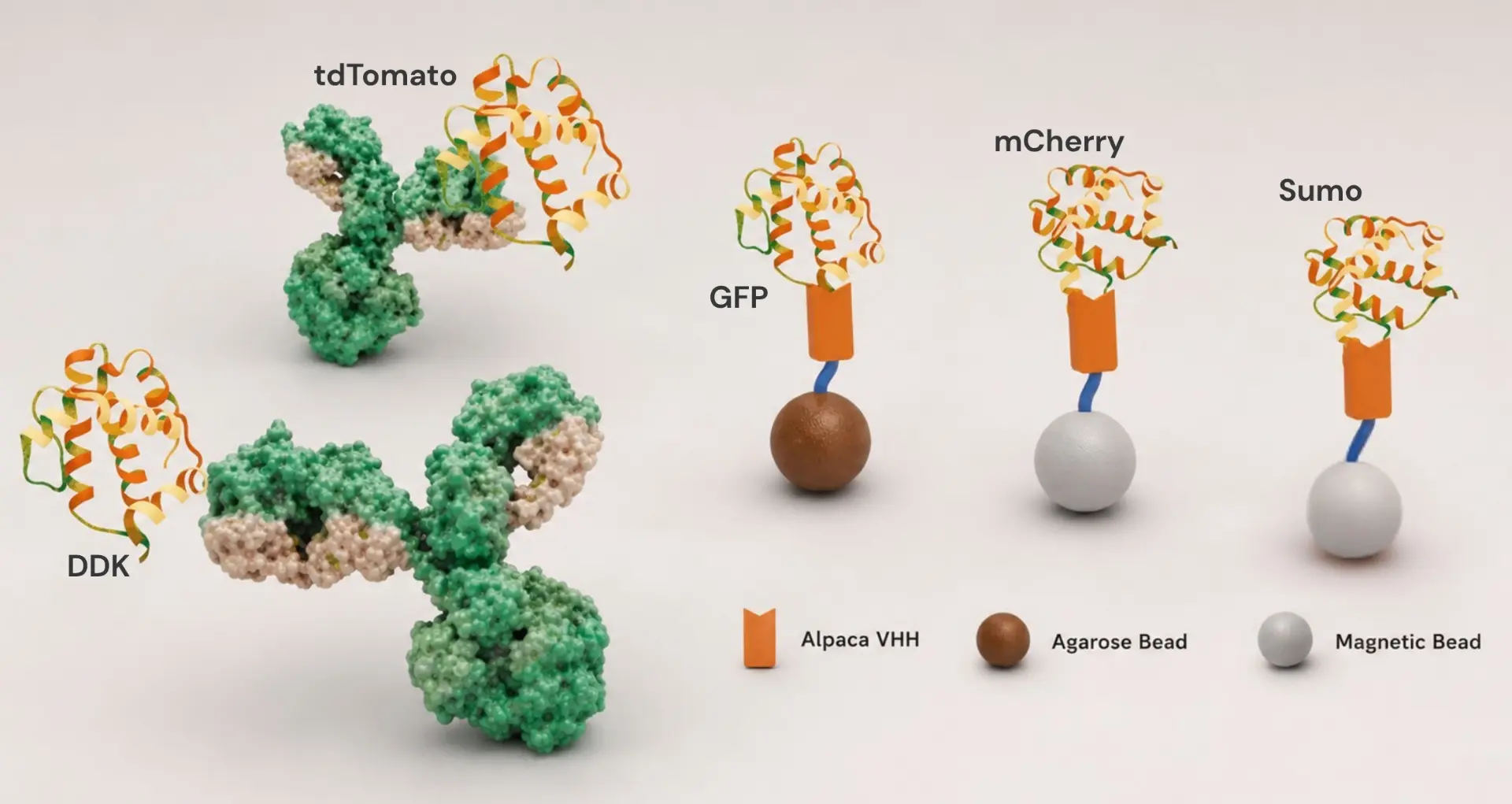
Two complementary formats for every workflow
Whether you need antibodies for detection or bead-based tools for capture and purification, OriGene's anti-tag portfolio covers all major epitope tags.
Anti-Tag Antibodies
VHH Anti-Tag Beads
Anti-Tag Antibodies
Mouse, rabbit, goat, and chicken antibodies extensively validated for Western blot, immunofluorescence, immunoprecipitation, and flow cytometry. Available unconjugated or conjugated to HRP and fluorescent dyes.
VHH Anti-Tag Beads
Single-domain antibody fragments from alpaca, covalently coupled to agarose or magnetic beads. Eliminate heavy/light chain contamination and achieve cleaner pulldowns with shorter incubation times.
Browse products by tag target
Filter by tag family or jump straight to all VHH bead products. Available in agarose and magnetic formats.
Fluorescent Tags
Non-Fluorescent Tags
| Cat # | Product name | Format | Tag | Size | Price (USD) | |
|---|---|---|---|---|---|---|
| Details → |
Purifying DDK-tag protein?
Learn more about DDKTrap Anti-DDK Affinity Resin.
Explore our recombinant fluorescent proteins
Engineered for bright signal, stability, and reproducibility across experiments.
VHH beads vs. conventional antibody beads
A direct technical comparison across the parameters that matter most for immunoprecipitation and protein purification workflows.
| Feature | VHH Anti-Tag Beads | Conventional Ab Beads |
|---|---|---|
| Bead coupling method | Covalent (direct) | Protein A/G intermediate |
| Heavy/light chain contamination | None | Present in eluate |
| Incubation time | 5–30 minutes | 1–4 hours typical |
| Buffer / pH tolerance | Broad (acid, alkali, reducing) | Limited – IgG sensitive to extremes |
| Lot-to-lot reproducibility | High (recombinant) | Variable |
| WB band interference | Antibody undetectable by WB | Heavy/light chain bands visible |
| Compatible with MS/proteomics | Excellent | Requires IgG depletion steps |
| Target size coverage | Same as conventional | Same as VHH |
Frequently asked questions
Answers to the most common questions about anti-tag antibodies and VHH bead products.
What is a VHH antibody (nanobody) and why is it useful for immunoprecipitation? +
VHH antibodies — also called nanobodies — are the variable domain of heavy-chain-only antibodies naturally found in camelids such as alpacas and llamas. At approximately 15 kDa, they are the smallest naturally occurring antigen-binding fragments. When coupled to beads, they provide all the binding affinity of a full IgG without the associated heavy and light chains that co-elute in conventional IP experiments, making downstream Western blot and mass spectrometry analysis far cleaner.
What is the difference between agarose beads and Magnetic beads? +
Both formats carry the same VHH and deliver equivalent binding performance. Agarose beads are pelleted by centrifugation — the classical approach that requires no specialized equipment. Magnetic beads are separated using a magnet, offering faster processing, reduced bead loss during washing, and easier automation in high-throughput settings.
What applications are VHH beads suitable for? +
VHH beads are well-suited for immunoprecipitation (IP) and co-immunoprecipitation (Co-IP) applications, enabling efficient and specific protein capture.
Are anti-tag and anti-fluorescent protein antibodies available in conjugated formats? +
Yes. OriGene offers a variety of conjugated formats of anti-tag and anti-fluorescent protein antibodies to support different experimental needs.
Which anti-DDK antibody you recommend? +
OriGene's anti-DDK monoclonal antibody OT14C5 (TA50011) has been cited in more than 200 publications. However, this antibody doesn’t recognize N-terminus DDK tag. OriGene offers a new anti-DDK monoclonal antibody clone OTI5G2 (TA592569) which recognizes both C- and N-terminus DDK tag.
How should VHH beads be stored and how long are they stable? +
VHH beads should be stored at 4°C and not frozen. They are stable for 12 months from the date of manufacture when stored correctly. Avoid repeated freeze-thaw cycles, which can compromise bead integrity and binding capacity.
Resources & protocols
Technical documentation to support your anti-tag and VHH bead experiments.
| Antibody Resources |