
Antibodies for Flow Cytometry
Flow cytometry enables rapid, multi-parameter analysis of millions of cells, providing precise insights into cell phenotype, function, and state. Whether you are profiling immune cell subsets, detecting intracellular targets, performing cell cycle analysis, or sorting live populations, high-quality antibodies are essential for accuracy and reproducibility.
Our flow cytometry antibodies are validated for specificity, brightness, and consistency. Available in a wide selection of fluorescent dye conjugates, formats, and host species, our reagents support both direct and indirect detection workflows across diverse research areas including immuno-oncology, immunology, stem cell biology, neurobiology, and cytokine signaling.
Product Categories
Conjugated Flow Cytometry Antibodies
Conjugated antibodies optimized with popular dyes: ABflo 450, ABflo 488, Alexa Fluor 488, DyLight 488, Alexa Fluor 546, DyLight 550, ABflow 594, DyLight 633, ABflo 647, Alexa Fluor 647, ABflo 700, APC, FITC, PE, and more... for flow cytometry experiments.
Intracellular Flow Antibodies
Range of conjugated antibodies for intracellular flow cytometry single cell analysis.
Unconjugated Flow Cytometry Antibodies
Unconjugated primary antibodies validated for use in flow cytometry experiments.
Popular Conjugated Antibodies for Flow Cytometry
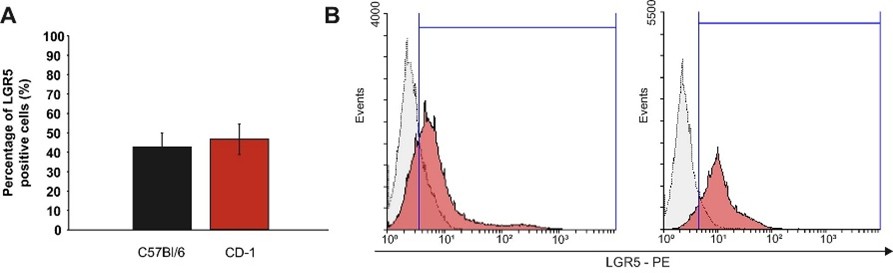
LGR5
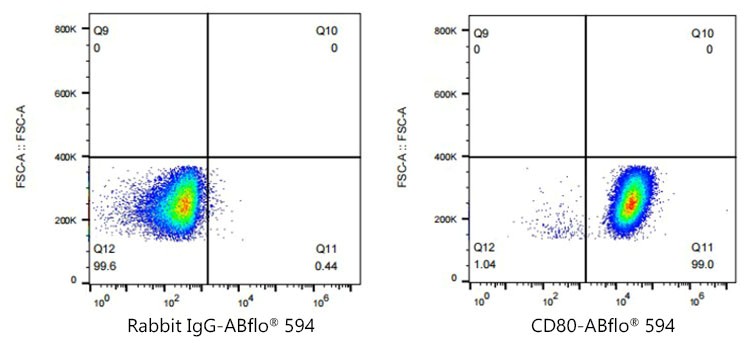
CD80
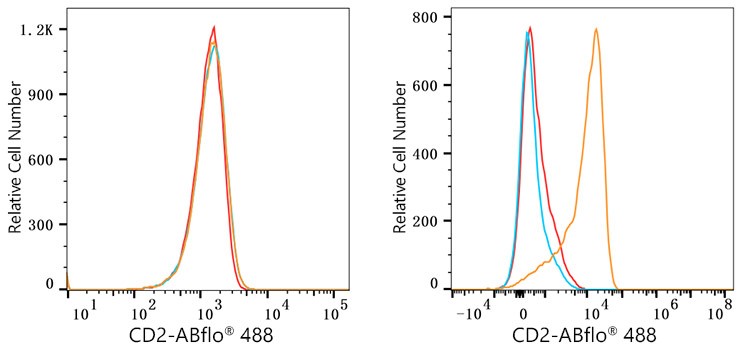
CD2
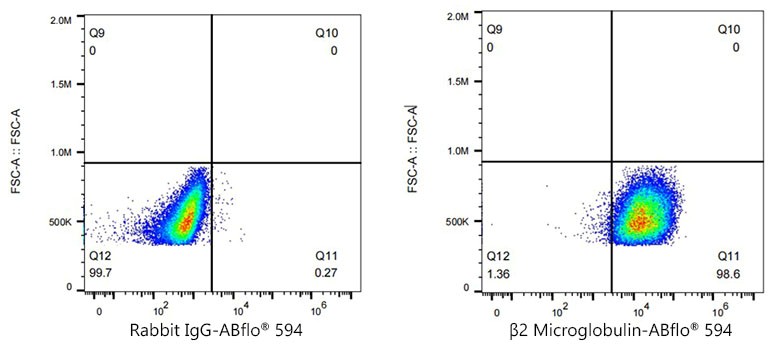
B2M
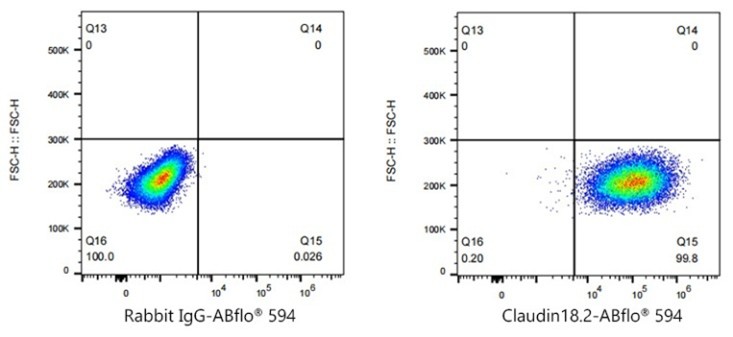
Caludin18.2
Flow Antibodies for Common Immunocyte Markers
Flow cytometry is widely used to profile immune cell populations by detecting multiple immunological markers. This approach provides valuable insights for immunology research and plays an important role in understanding and treating autoimmune disorders, cancers, and other diseases.
Flow Antibodies by Research Applications or Functional Categories
Explore our flow antibodies for immunophenotyping by their function or research interests.
Common Fluorescent Dye Options
Our antibodies conjugated with popular fluorescent dye conjugates provide high stability, broad pH tolerance, and excellent compatibility with common flow cytometers and cell sorters.
| Dye Name | Spectra | Max Excitation Wavelength (nm) | Max Emission Wavelength (nm) | Spectrally Similar Dyes |
|---|---|---|---|---|
| Alexa Fluor 488 |
|
490 | 525 | FITC, BB515, Alexa Fluor 488, DyLight 488 |
| FITC |
|
491 | 516 | Abflo 488, Alexa Fluor 488, BB515, DyLight 488 |
| Abflo 488 |
|
491 | 516 | FITC, BB515, Alexa Fluor 488, DyLight 488 |
| Alexa Fluor 488 |
|
490 | 525 | FITC, BB515, Alexa Fluor 488, DyLight 488 |
| DyLight 488 |
|
493 | 518 | Alexa Fluor 488, Abflow 488, FITC |
| PE |
|
565 | 574 | |
| Abflo 594 |
|
588 | 604 | Alexa Fluor 594, ECD |
| DyLight 633 |
|
638 | 658 | Alexa Fluor 633 |
| Abflo 647 |
|
648 | 664 | APC, Alexa Fluor 647, eFluor660 |
| APC |
|
650 | 660 | Abflo 647, Alexa Fluor 647, eFluor660 |
| Alexa Fluor 647 |
|
650 | 671 | APC, Alexa Fluor 647, eFluor660 |
| Abflo 700 |
|
690 | 713 | Alexa Fluor 700, APC-Alexa Fluor 700 |
OriGene offers several custom conjugation options to meet your individual project needs. Click here to inquire
| Antibody Resources |
