
EV Isolation Reagent
High yield and ultracentrifuge-free EV isolation
OriGene’s EV isolation kit is based on polymer precipitation, providing a powerful alternative to ultracentrifugation and chromatography for isolating extracellular vesicles (EVs) from cell culture media.
A smarter method for exosome isolation and characterization
- High Yield Recovery — Recover more EVs than ultracentrifugation and similar products from other vendors
- Fast & Simple Protocol — Complete isolation of EVs in < 2 hours; no ultracentrifuge required
- Flexible & Scalable — Works with 0.5mL to up to 200 mL samples per kit
- Affordable — Cost-effective exosome concentration kit vs. ultracentrifuge and SEC
| SKU | Description | Add to Cart |
|---|---|---|
| EV Isolation Reagent, 15 mL |
$300.00
|
|
| EV Isolation Reagent, 50 mL |
$470.00
|
A smarter method for exosome isolation and characterization
- High Yield Recovery — Recover more EVs than ultracentrifugation and similar products from other vendors
- Fast & Simple Protocol — Complete isolation of EVs in < 2 hours; no ultracentrifuge required
- Flexible & Scalable — Works with 0.5mL to up to 200 mL samples per kit
- Affordable — Cost-effective exosome concentration kit vs. ultracentrifuge and SEC
| SKU | Description | Add to Cart |
|---|---|---|
| EV Isolation Reagent, 15 mL |
$300.00
|
|
| EV Isolation Reagent, 50 mL |
$470.00
|
Product Overview:
EV Yield Comparison with Ultracentrifugation and Vendor Q
Figure 1A. Nanoparticle tracking analysis (NTA) demonstrated significantly higher EV recovery (>10-fold) using OriGene's EV isolation reagent compared to ultracentrifugation. EVs were isolated from HEK293 cell culture supernatants.
Figure 1B. BCA and Western blot analysis of EVs from stem cell conditioned medium showed that OriGene's EV isolation reagent produced higher EV yields than Vendor Q, confirmed by stronger CD81 signals and greater protein content.
Stable and High-quality EV
Figure 2. EVs isolated from HeLa cells using OriGene's EV isolation reagent showed good stability by Zeta potential analysis, with size and integrity comparable to ultracentrifugation, confirming their high quality.
Efficient Uptake of Labeled EVs: Cell Uptake Assay
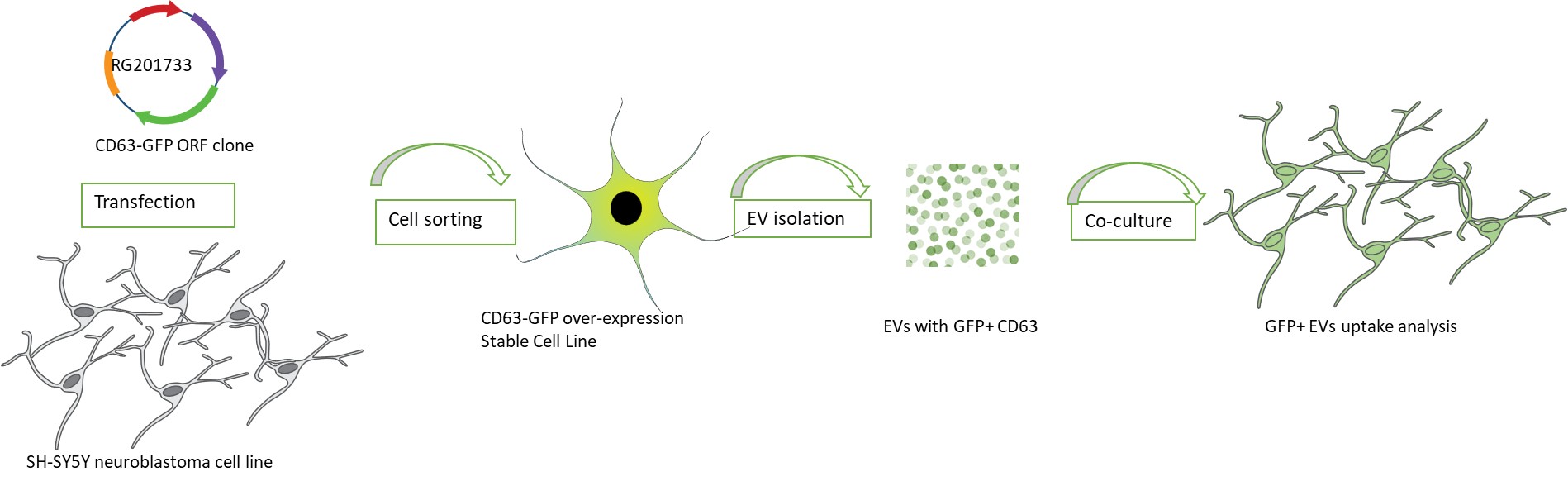
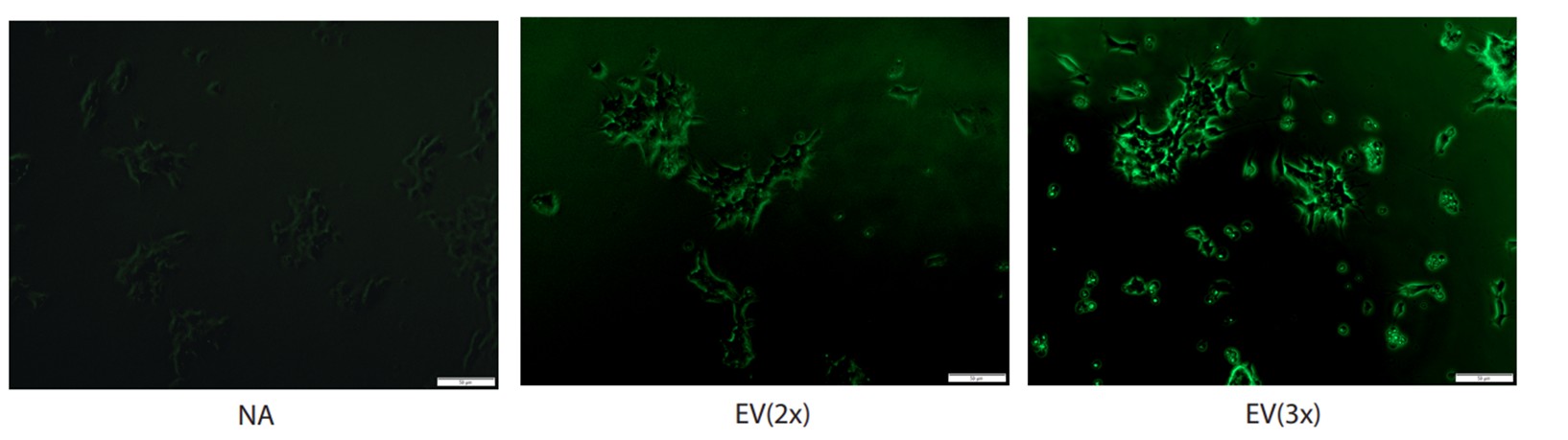
Figure 3. GFP-tagged EVs from a stable CD63-GFP cell line were isolated using OriGene's EV isolation reagent and co-cultured with naïve SH-SY5Y cells. After 72 hours, efficient, dose-dependent uptake confirmed their functional delivery capability.
EV Marker Validation
Figure 4. Simple Western analysis of HEK293T-derived EVs isolated using the OriGene's EV isolation reagent showed clear detection of EV markers using CD63 mouse mAb (SKU: TA803474), TSG101 mAb (SKU: TA385476), CD81 mAb, and MFGE8 mAb (SKU: TA809279). EVs were diluted to 0.2 mg/ml (protein equivalence) and analyzed with the Jess system. Jess Simple Western system.
Simple Protocol: Mix, Incubate, and Resuspend
Complete EV Research Solutions
Isolation
- Precipitation Method
- Polymer-based
- Immunocapture Method
- High-affinity antibody coupled to magnetic beads
Detection
- EV Markers
- Antibodies against general EV markers
- Full-length recombinant EV marker proteins for use as a standard in immunoassays
- ELISA Kit for detection of EV markers
Cargo Analysis
- miRNA
- qPCR miRNA detection system
- Disease Markers
- Antibody against EV enriched biomarkers
Functional Analysis
- GFP-Tag clone
- Florescent EV markers for analysis
- miRNA Validation Vectors
- Over-expression and miRNA target vectors of your choice
Need Help Getting Started?
Contact our technical support team for protocol guidance, compatibility questions, or to request a bulk or custom quote.
Email: techsupport@origene.com
Phone: 1-888-267-4436
Live Chat: Available Mon–Fri 9 AM–5 PM EST
