
Mouse Epha4 activation kit by CRISPRa
$1,657.00
4 Weeks*
Specifications
| Product Data | |
| Format | 3 gRNAs (5ug each), 1 scramble ctrl (10ug) and 1 enhancer vector (10ug) |
|---|---|
| Target Symbol | Epha4 |
| Locus ID | 13838 |
| Components |
GA201259G1, Epha4 gRNA vector 1 in pCas-Guide-GFP-CRISPRa GA201259G2, Epha4 gRNA vector 2 in pCas-Guide-GFP-CRISPRa GA201259G3, Epha4 gRNA vector 3 in pCas-Guide-GFP-CRISPRa 1 CRISPRa-Enhancer vector, SKU GE100056 1 CRISPRa scramble vector, SKU GE100077 |
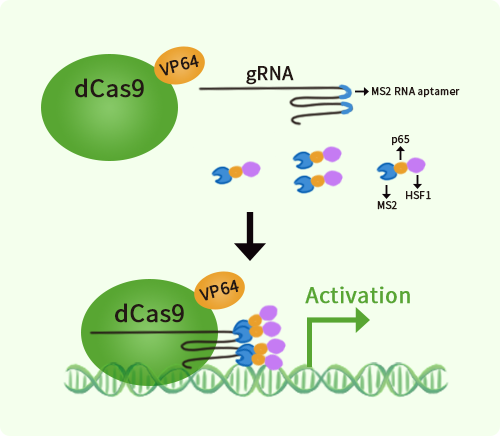
| OTI Disclaimer | These products are manufactured and supplied by OriGene under license from ERS. The kit is designed based on the best knowledge of CRISPRa SAM technology. The efficiency of the activation can be affected by many factors, including nucleosome occupancy status, chromatin structure and the gene expression level of the target, etc. |
| Shipping | Ambient |
| Reference Data | |
| RefSeq | NM_007936 |
| UniProt ID | Q03137 |
| Synonyms | 2900005C20Rik; AI385584; Cek8; Hek8; rb; Sek; Sek1; Tyro1 |
| Summary | Receptor tyrosine kinase which binds membrane-bound ephrin family ligands residing on adjacent cells, leading to contact-dependent bidirectional signaling into neighboring cells. The signaling pathway downstream of the receptor is referred to as forward signaling while the signaling pathway downstream of the ephrin ligand is referred to as reverse signaling. Highly promiscuous, it has the unique property among Eph receptors to bind and to be physiologically activated by both GPI-anchored ephrin-A and transmembrane ephrin-B ligands including EFNA1 and EFNB3. Upon activation by ephrin ligands, modulates cell morphology and integrin-dependent cell adhesion through regulation of the Rac, Rap and Rho GTPases activity. Plays an important role in the development of the nervous system controlling different steps of axonal guidance including the establishment of the corticospinal projections. May also control the segregation of motor and sensory axons during neuromuscular circuit development. In addition to its role in axonal guidance plays a role in synaptic plasticity. Activated by EFNA1 phosphorylates CDK5 at 'Tyr-15' which in turn phosphorylates NGEF regulating RHOA and dendritic spine morphogenesis. In the nervous system, plays also a role in repair after injury preventing axonal regeneration and in angiogenesis playing a role in central nervous system vascular formation. Additionally, its promiscuity makes it available to participate in a variety of cell-cell signaling regulating for instance the development of the thymic epithelium.UniProtKB/Swiss-Prot Function |
Reviews


Documents
| Product Manuals |
| FAQs |
| SDS |
Resources
Other Versions
| SKU | Description | Size | Price | |
|---|---|---|---|---|
| KN505278 | Epha4 - KN2.0, Mouse gene knockout kit via CRISPR, non-homology mediated. | 1 kit |
$1,657.00
|
|
Citations
*Delivery time may vary from web posted schedule. Occasional delays may occur due to unforeseen
complexities in the preparation of your product. International customers may expect an additional 1-2 weeks
in shipping.
Related Products
- Price:
- Actual Price:
Welcome to OriGene AI!
I'm your AI-powered guide to everything OriGene.
Ask me anything:
- Product specs
- Ordering help
- Technical questions
- How to find exactly what your experiment needs
Prefer a live agent? Connect with us by clicking the green chat icon, as seen in the image below or email our team at custsupport@origene.com.
