
Human USP13 activation kit by CRISPRa
$1,657.00
4 Weeks*
Specifications
| Product Data | |
| Format | 3 gRNAs (5ug each), 1 scramble ctrl (10ug) and 1 enhancer vector (10ug) |
|---|---|
| Target Symbol | USP13 |
| Locus ID | 8975 |
| Components |
GA105971G1, USP13 gRNA vector 1 in pCas-Guide-GFP-CRISPRa GA105971G2, USP13 gRNA vector 2 in pCas-Guide-GFP-CRISPRa GA105971G3, USP13 gRNA vector 3 in pCas-Guide-GFP-CRISPRa 1 CRISPRa-Enhancer vector, SKU GE100056 1 CRISPRa scramble vector, SKU GE100077 |
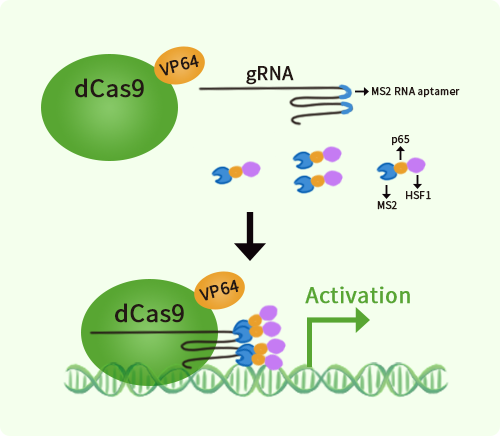
| OTI Disclaimer | These products are manufactured and supplied by OriGene under license from ERS. The kit is designed based on the best knowledge of CRISPRa SAM technology. The efficiency of the activation can be affected by many factors, including nucleosome occupancy status, chromatin structure and the gene expression level of the target, etc. |
| Shipping | Ambient |
| Reference Data | |
| RefSeq | NM_003940 |
| UniProt ID | Q92995 |
| Synonyms | IsoT-3; ISOT3 |
| Summary | Deubiquitinase that mediates deubiquitination of target proteins such as BECN1, MITF, SKP2 and USP10 and is involved in various processes such as autophagy and endoplasmic reticulum-associated degradation (ERAD). Component of a regulatory loop that controls autophagy and p53/TP53 levels: mediates deubiquitination of BECN1, a key regulator of autophagy, leading to stabilize the PIK3C3/VPS34-containing complexes. Also deubiquitinates USP10, an essential regulator of p53/TP53 stability. In turn, PIK3C3/VPS34-containing complexes regulate USP13 stability, suggesting the existence of a regulatory system by which PIK3C3/VPS34-containing complexes regulate p53/TP53 protein levels via USP10 and USP13. Recruited by nuclear UFD1 and mediates deubiquitination of SKP2, thereby regulating endoplasmic reticulum-associated degradation (ERAD). Also regulates ERAD through the deubiquitination of UBL4A a component of the BAG6/BAT3 complex. Mediates stabilization of SIAH2 independently of deubiquitinase activity: binds ubiquitinated SIAH2 and acts by impairing SIAH2 autoubiquitination. Has a weak deubiquitinase activity in vitro and preferentially cleaves 'Lys-63'-linked polyubiquitin chains. In contrast to USP5, it is not able to mediate unanchored polyubiquitin disassembly. Able to cleave ISG15 in vitro; however, additional experiments are required to confirm such data.UniProtKB/Swiss-Prot Function |
Reviews


Documents
| Product Manuals |
| FAQs |
| SDS |
Resources
Other Versions
| SKU | Description | Size | Price | |
|---|---|---|---|---|
| KN202190 | USP13 - human gene knockout kit via CRISPR, HDR mediated | 1 kit |
$1,657.00
|
|
| KN202190BN | USP13 - human gene knockout kit via CRISPR, HDR mediated | 1 kit |
$1,657.00
|
|
| KN202190LP | USP13 - human gene knockout kit via CRISPR, HDR mediated | 1 kit |
$1,657.00
|
|
| KN202190RB | USP13 - human gene knockout kit via CRISPR, HDR mediated | 1 kit |
$1,657.00
|
|
| KN402190 | USP13 - KN2.0, Human gene knockout kit via CRISPR, non-homology mediated. | 1 kit |
$1,657.00
|
|
Citations
*Delivery time may vary from web posted schedule. Occasional delays may occur due to unforeseen
complexities in the preparation of your product. International customers may expect an additional 1-2 weeks
in shipping.
Related Products
- Price:
- Actual Price:
Welcome to OriGene AI!
I'm your AI-powered guide to everything OriGene.
Ask me anything:
- Product specs
- Ordering help
- Technical questions
- How to find exactly what your experiment needs
Prefer a live agent? Connect with us by clicking the green chat icon, as seen in the image below or email our team at custsupport@origene.com.
