
- Natalia Gomez-Navarro
- Blog
- Feb 17, 2026
-
113views
- Reading time: 4 minutes
3 Truths About Proving Your CRISPR Edit Worked
Introduction: The Hidden Hurdle in the Gene Editing Revolution
CRISPR has transformed biology from a slow, incremental science into a precision-driven discipline. With unprecedented ease, researchers can now knock out genes, introduce mutations, or engineer entire pathways. The excitement is justified - few technologies have moved so quickly from discovery to everyday laboratory use.
Yet as CRISPR tools have become easier to deploy, a new challenge has quietly become the real bottleneck: proof.
Making the edit is no longer the hard part. Proving that the edit worked, that it produced the intended protein-level and functional outcome, is where many experiments stall. For both basic research and therapeutic development, validation is non-negotiable. So, you’ve made a CRISPR edit. How do you really know it worked?
Truth #1: The Real Bottleneck Is the Proof
Modern CRISPR systems are efficient, modular, and widely available (CRISPR tools). However, confirmation of a successful edit requires far more than sequencing a target locus. Genotyping alone can suggest that a change occurred at the DNA level, but it does not reveal whether the CRISPR machinery entered the cells efficiently, whether protein expression changed as expected, whether the edit altered cellular function, or whether off-target or toxic effects occurred.
A robust validation strategy must therefore address accuracy, efficiency, and biological consequences. Without this deeper confirmation, even a perfectly designed guide RNA can yield ambiguous or misleading results.
Truth #2: CRISPR Validation Is a Three-Act Play
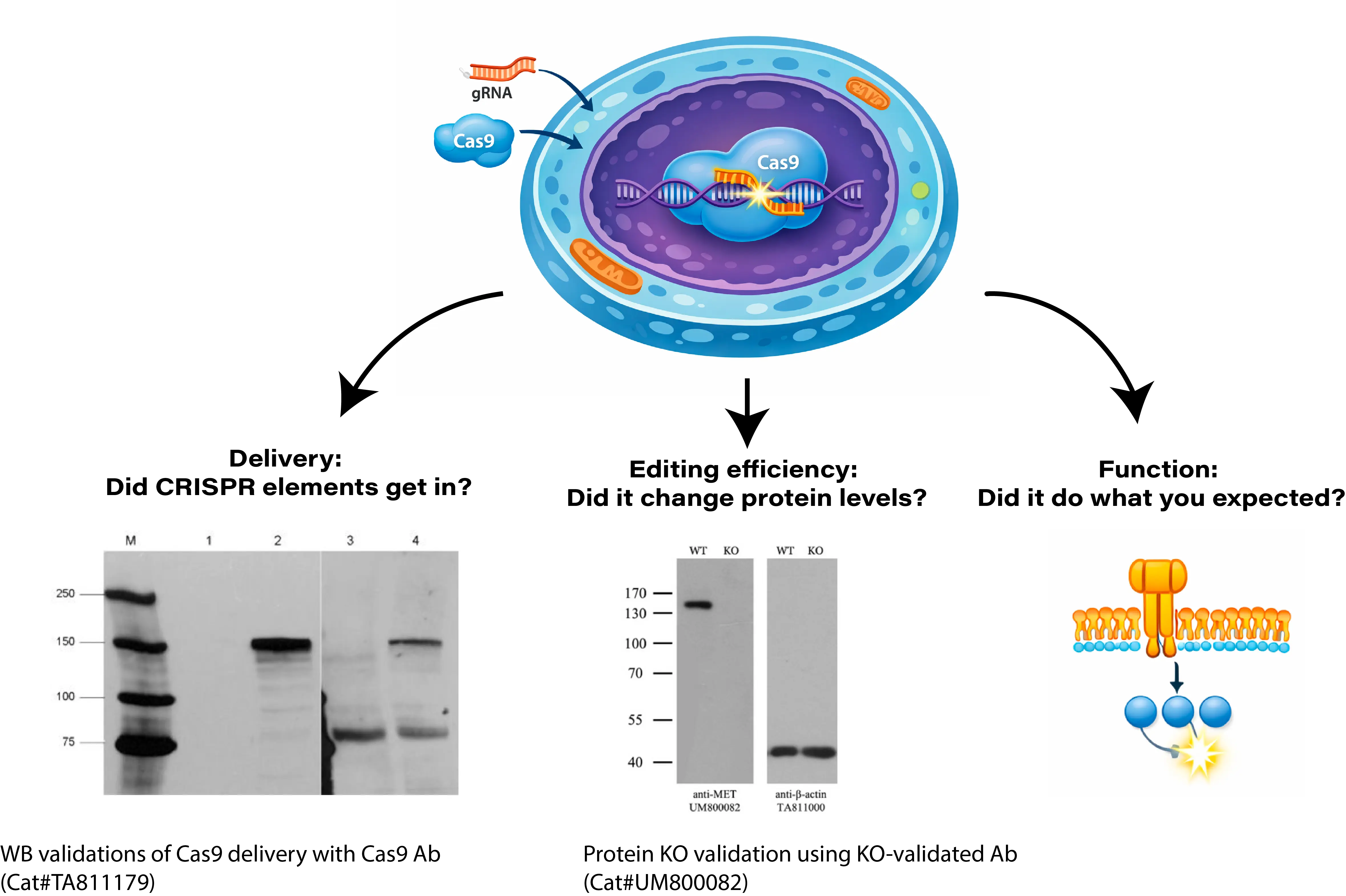
Every successful CRISPR experiment follows a predictable validation arc that moves from delivery, to editing efficiency and finally to function.
The first step is confirming delivery. Before asking whether editing occurred, researchers must establish that the CRISPR components reached the target cells. Common approaches include fluorescent reporters, antibiotic selection, or direct detection of Cas9 itself. Protein-level confirmation is particularly powerful, as detecting Cas9 by western blot (WB) or immunofluorescence (IF) removes guesswork and confirms true intracellular delivery. Using validated anti-Cas9 antibodies allows researchers to directly verify that the editing machinery is present inside cells before moving downstream. (WB and IF validated anti-Cas9)
Once delivery is confirmed, attention shifts to editing efficiency. At this stage, the question is how many cells were successfully edited and how clean the edit was. DNA-based methods such as cleavage detection assays, PCR, or sequencing are often combined with protein-level analysis using western blotting. This step is critical because DNA changes must ultimately translate into altered protein expression. Proper controls are essential here, as incomplete knockouts, residual protein, or variable expression can easily be misinterpreted without reliable reference points. Validated knockdown and overexpression cell lysates provide the necessary context to interpret protein-level changes confidently.
The final act is confirming the phenotype. A confirmed edit is only meaningful if it produces the expected biological effect. Depending on the gene target, this may involve loss-of-function or gain-of-function cell-based assays, signaling pathway activation or suppression, or changes in proliferation, differentiation, or metabolism. At this stage, researchers move beyond molecular confirmation and ask the most important question: Did the edit change what the cell does?
Truth #3: First, Do No Harm - Cell Health Is Part of Validation
A perfectly edited gene in an unhealthy or dying cell is not a successful outcome. CRISPR workflows can stress cells through transfection toxicity, DNA damage responses, or unintended off-target effects. For this reason, assessing cell health should be considered a core component of validation rather than an optional add-on.
Metrics such as apoptosis, oxidative stress, protein synthesis, protein degradation, and morphological changes provide essential context for interpreting editing results. High-content screening platforms make this type of multi-parameter analysis feasible by combining automated imaging with multiplexed fluorescent readouts. This approach allows researchers to evaluate editing success and cellular health simultaneously, ensuring that observed phenotypes are not artifacts of cellular stress or toxicity.
Conclusion: From “Did It Cut?” to “Did It Work?”
CRISPR validation is no longer a single checkpoint but a comprehensive workflow. True success requires confirming reagent delivery, verifying protein-level changes, demonstrating functional consequences, and ensuring overall cellular health. An edit that appears correct at the DNA level but fails to alter protein expression or compromises cell viability is not a meaningful success, particularly in therapeutic contexts.
By shifting the focus from “Did it cut?” to “Did it work?”, researchers build experiments that are more reproducible, interpretable, and biologically relevant. As CRISPR technologies continue to evolve, so must our standards for proof. The future of gene editing depends not only on precision but on confidence built through rigorous validation.
