
LIQUID BIOPSY · EXTRACELLULAR VESICLES
From Plasma to Prognostic Insights: 15-Minute EV Isolation Breaking the Bottleneck in Pancreatic Cancer Liquid Biopsy Research
The Challenge: Monitoring a Difficult-to-Detect Cancer
Monitoring pancreatic ductal adenocarcinoma (PDAC) remains a major challenge in oncology. Because the pancreas is located deep within the abdomen, imaging can be challenging for detecting early recurrence or subtle changes in tumor progression. Furthermore, the clinical "gold standard" biomarker, CA19-9, is notoriously unreliable — it is frequently elevated by non-cancerous biliary inflammation and remains entirely uninformative in the significant subset of patients who are Lewis-antigen non-secretors.
Extracellular Vesicles (EVs) have long been recognized as a potential solution. These lipid-bilayer particles are released by tumor cells into the circulation and can carry double-stranded DNA that reflects genomic alterations present in tumor cells. However, EV-based analysis has been limited in part by the challenges in EV isolation. Traditional approaches such as ultracentrifugation can be time-consuming, labor-intensive, and difficult to standardize, limiting their scalability in research and clinical workflows. MagExo™ technology effectively collapses this bottleneck, transforming EV-DNA from a research curiosity into a fast, actionable clinical tool.
Takeaway 1. KRAS Provides a Strong Molecular Signal in PDAC Biomarkers
While general markers of inflammation can cloud the diagnostic picture, KRAS mutations offer an uncompromising "True North." As the principal oncogenic driver of PDAC, KRAS mutations are present in over 90% of cases and represent one of the earliest events in tumor formation. Because these mutations do not occur in healthy cells, detecting mutant KRAS in the blood provides a nearly 100% tumor-specific readout. This shifts the clinical paradigm from a binary "yes/no" result to a sophisticated, quantitative "dial" known as the Mutant Allele Frequency (MAF).
Takeaway 2. From Centrifuges to Chemistry: A 15-Minute EV Isolation Workflow
One challenge in translating EV analysis to higher-throughput workflows is the time and hands-on effort required for EV isolation. MagExo™ reimagines this process by utilizing a lipid nanoprobe that rapidly intercalates into the phospholipid bilayer of the EV membrane. This "structure-based capture" is a significant departure from traditional methods; because it does not rely on a single surface antigen, it avoids the tetraspanin antibody/marker bias that can lead to incomplete vesicle populations. The workflow is designed with higher-throughput laboratory processing in mind:
- 15–30 minute, one-step isolation directly from plasma.
- Automation-compatible magnetic-bead format for reproducible processing.
- A clean, unbiased fraction ready for ddPCR, qPCR, NGS, and proteomics.
The MagExo™ workflow is readily translatable to a Clinical Laboratory Improvement Amendments (CLIA) laboratory-developed test, moving EV isolation out of the research silo and into high-throughput clinical environments where it can influence patient care.
Takeaway 3. A 0.01% MAF Limit of Detection
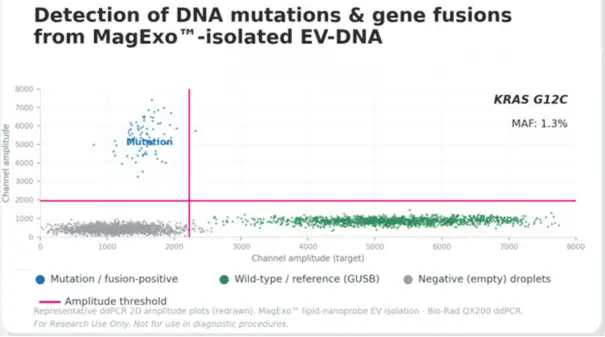
For early-stage disease detection or monitoring of minimal residual disease, a liquid biopsy must be sufficiently sensitive to detect low-frequency molecular signals. By pairing MagExo™ isolation with a tumor-informed, single-plex droplet digital PCR (ddPCR) design, researchers have established a 0.01% MAF limit of detection (LoD). The choice of a single-plex assay is an analytical design choice. This approach may reduce assay crosstalk that can complicate interpretation at very low variant frequencies. A 0.01% LoD indicates the assay can detect low-frequency molecular signals within the reported analytical conditions.
Takeaway 4. Independent Prognostic Value
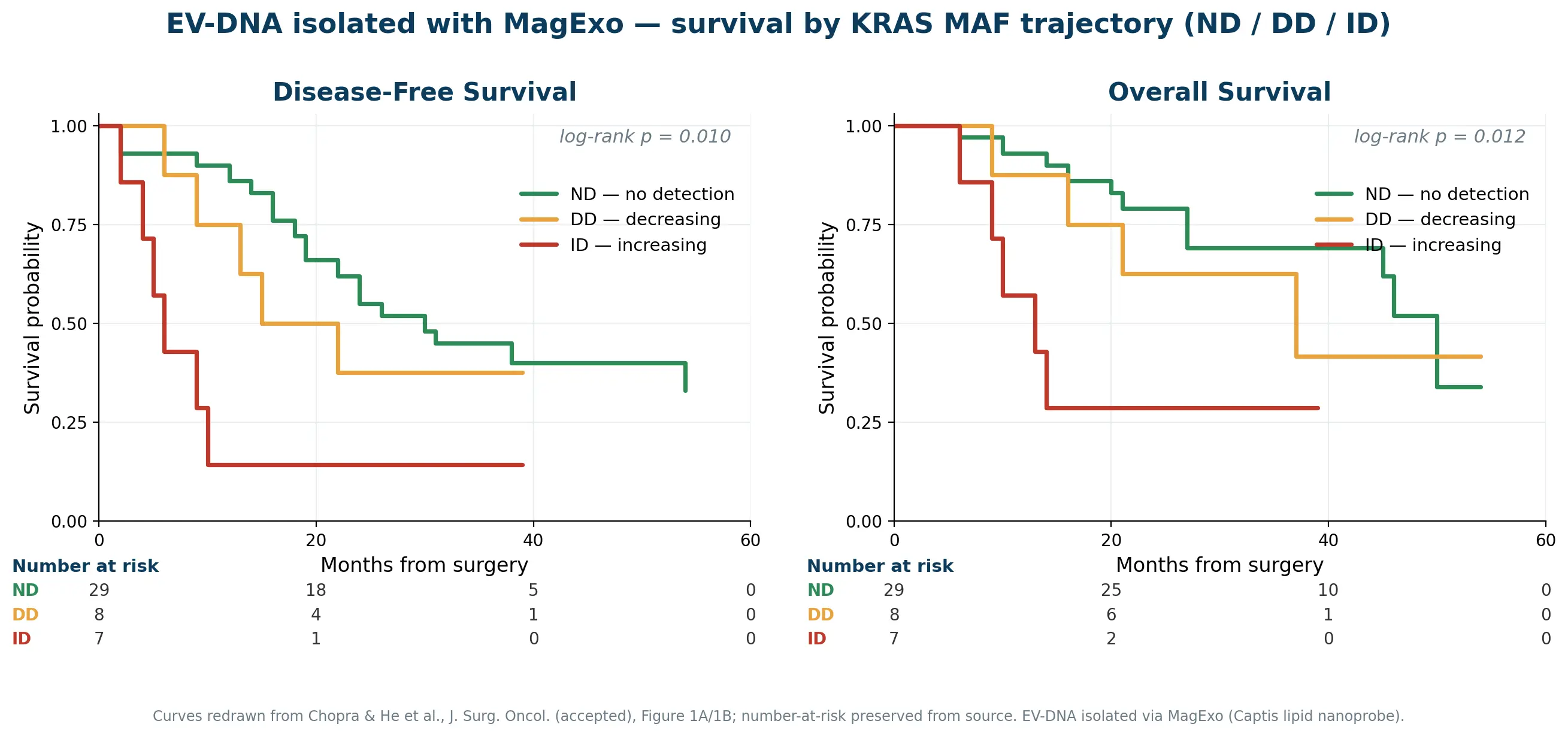
A groundbreaking study by Chopra, He, Milosevic et al. (Annals of Surgical Oncology, 2026) involving a cohort of 44 patients demonstrates that the trajectory of the EV-KRAS signal is a far more potent predictor of survival than any single baseline measurement. By tracking MAF at diagnosis, post-neoadjuvant therapy, and one month post-surgery, the researchers categorized patients into three distinct groups:
EV-KRAS MAF trajectory cohorts (Chopra, He, Milosevic et al., 2026; n = 44).
| Trajectory group | Definition | Cohort share |
|---|---|---|
| Never Detected (ND) | Signal remained undetectable at all time points. | 66% |
| Decreasing (DD) | Signal was detectable but fell toward clearance during treatment. | 18% |
| Increasing / Rising (ID) | Signal was detectable and continued to climb. | 16% |
The study reported substantially different outcomes of the ID group compared with patients whose EV-KRAS signal decreased or remained undetectable.
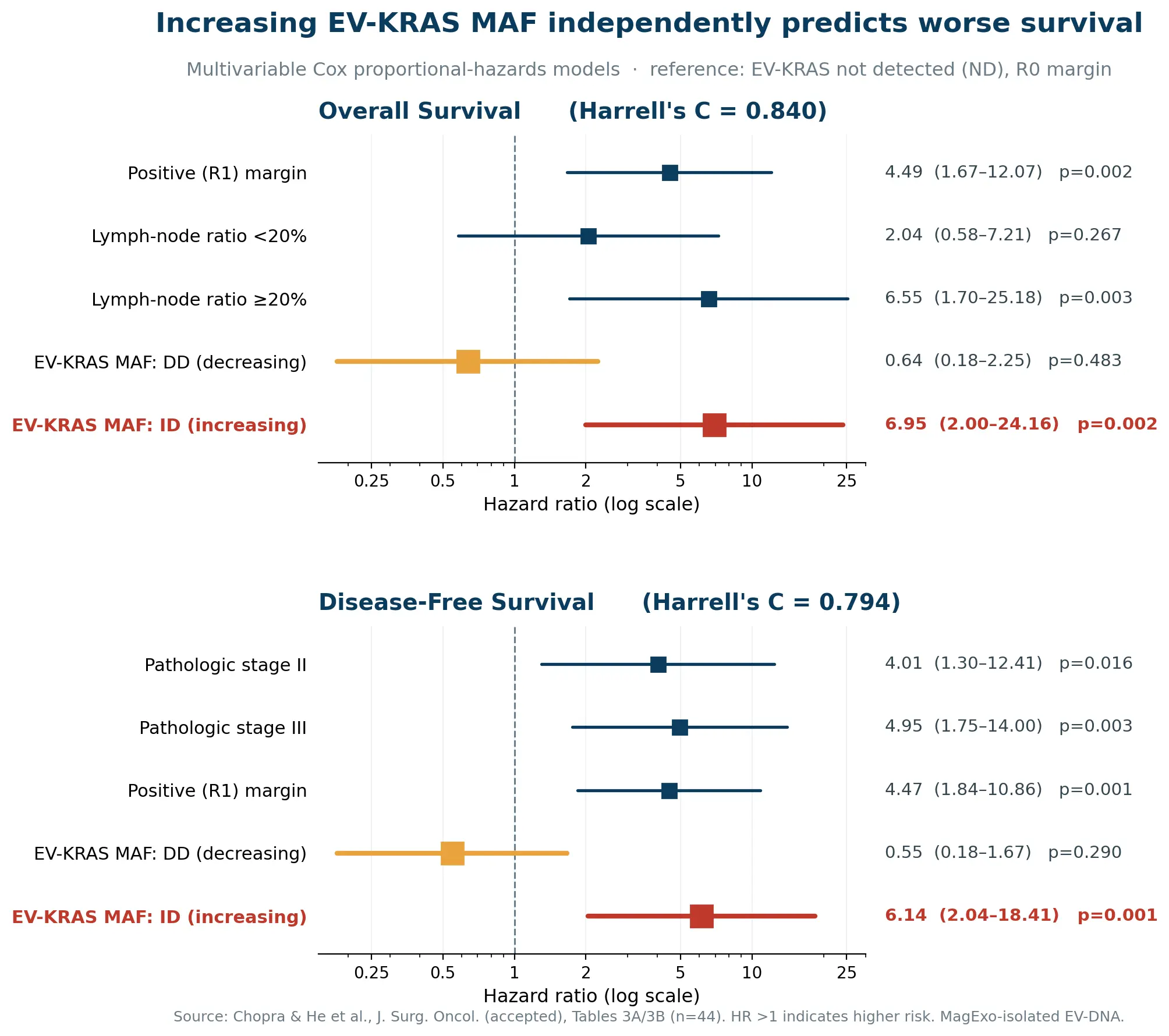
The potential value of EV-KRAS MAF is further supported by its independent prognostic association. In multivariable Cox models, a rising EV-KRAS trajectory remained a dominant predictor of outcome even after adjusting for standard clinicopathologic variables, including tumor stage, margin status, and lymph node ratio. Model discrimination was also reported to be strong, with Harrell's C indices of 0.84 and 0.79. For the clinician, this means that EV-KRAS provides information "beyond the standard workup." Such a signal could help identify patients with high-risk molecular trajectory, including some who otherwise appear to have favorable clinicopathologic features.
Bring EV-KRAS into your workflow
MagExo™ isolates EV-DNA from plasma in ~15 minutes on an automation-compatible magnetic-bead format, a clean, unbiased fraction ready for ddPCR, qPCR, NGS, and proteomics.
Conclusion: Toward More Accessible EV-based Liquid Biopsy Workflows
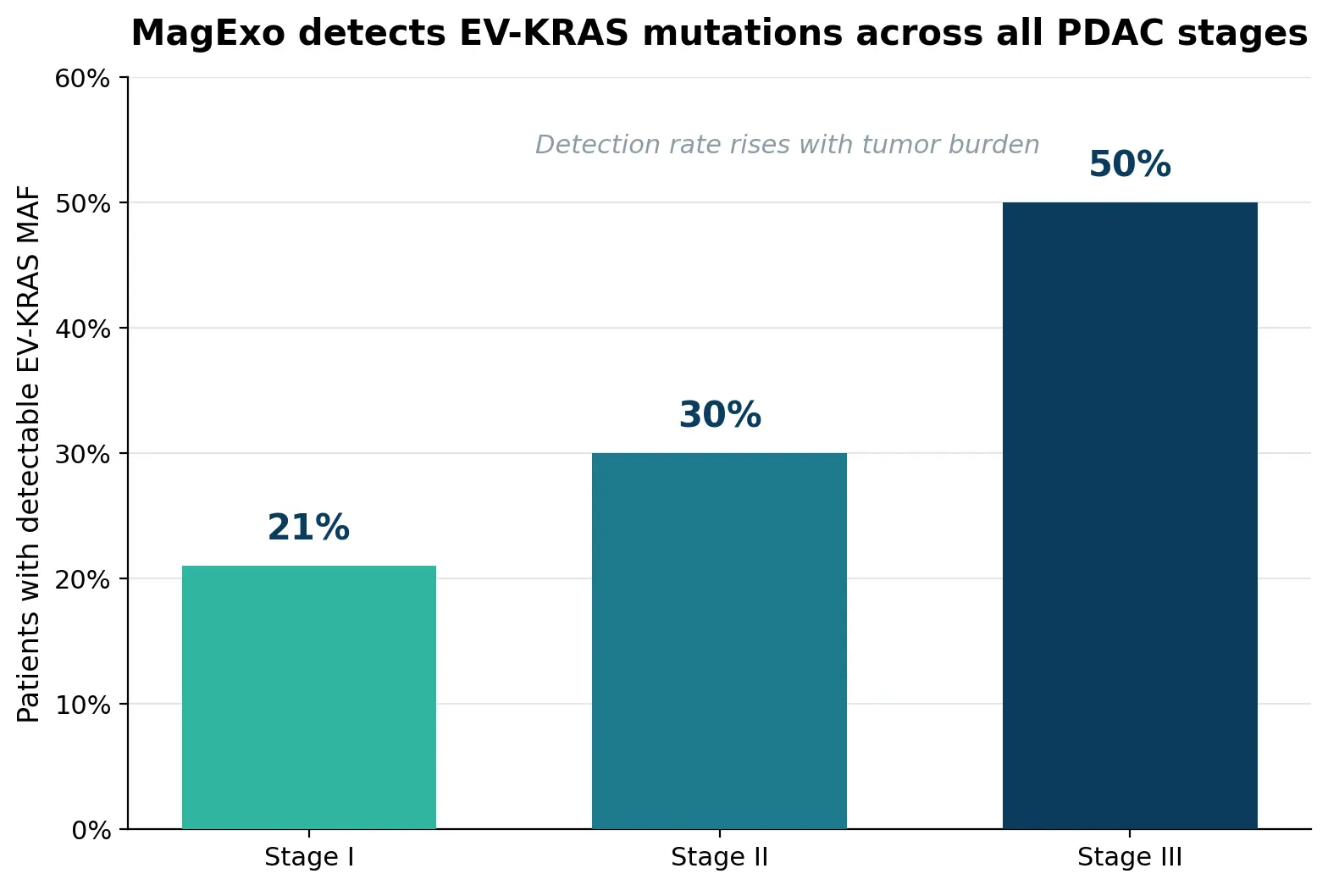
By removing the isolation bottleneck, MagExo™ turns the complex biology of extracellular vesicles into a standardized, high-speed tool. The data from Chopra, He, Milosevic et al. confirms that detection scales with tumor burden — found in 21% of stage I cases and rising to 50% in stage III — making it a true surrogate for disease state. With a rapid EV-isolation workflow, molecular trajectories could potentially be assessed more efficiently. Rather than relying on imaging alone to assess disease status, molecular measurements could provide an additional source of information about treatment response. This could ultimately help identify patients who may benefit from close surveillance or additional clinical evaluation. The question is no longer if we can see the signal, but how much sooner can we intervene to change the patient's course.
MagExo™ products are for Research Use Only. Not for use in diagnostic procedures. Clinical findings summarized from Chopra A, He HZ, Milosevic J, et al., Annals of Surgical Oncology (2026).
Reference
|
1 KRAS Mutation Allele Frequency Dynamics in Plasma Extracellular Vesicles: Association with Survival in Localized Pancreatic Adenocarcinoma Published in NLM |
PubMed: https://doi.org/10.1245/s10434-025-18633-7 |
