
Mouse Rc3h1 activation kit by CRISPRa
$1,657.00
4 Weeks*
Specifications
| Product Data | |
| Format | 3 gRNAs (5ug each), 1 scramble ctrl (10ug) and 1 enhancer vector (10ug) |
|---|---|
| Target Symbol | Rc3h1 |
| Locus ID | 381305 |
| Components |
GA217097G1, Rc3h1 gRNA vector 1 in pCas-Guide-GFP-CRISPRa GA217097G2, Rc3h1 gRNA vector 2 in pCas-Guide-GFP-CRISPRa GA217097G3, Rc3h1 gRNA vector 3 in pCas-Guide-GFP-CRISPRa 1 CRISPRa-Enhancer vector, SKU GE100056 1 CRISPRa scramble vector, SKU GE100077 |
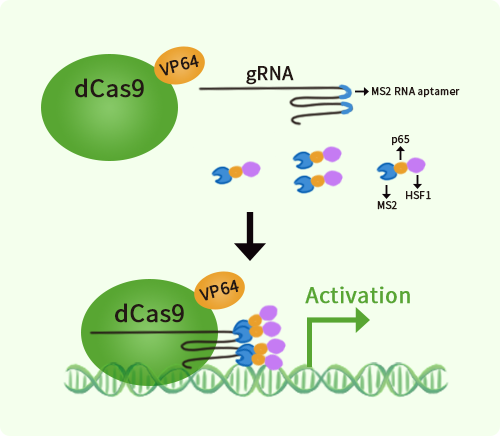
| OTI Disclaimer | These products are manufactured and supplied by OriGene under license from ERS. The kit is designed based on the best knowledge of CRISPRa SAM technology. The efficiency of the activation can be affected by many factors, including nucleosome occupancy status, chromatin structure and the gene expression level of the target, etc. |
| Shipping | Ambient |
| Reference Data | |
| RefSeq | NM_001024952 |
| UniProt ID | Q4VGL6 |
| Synonyms | 5730557L09Rik; Gm551; mKIAA2025; N28103 |
| Summary | Post-transcriptional repressor of mRNAs containing a conserved stem loop motif, called constitutive decay element (CDE), which is often located in the 3' UTR, as in HMGXB3, ICOS, IER3, NFKBID, NFKBIZ, PPP1R10, TNF, TNFRSF4 and in many more mRNAs (PubMed:23663784, PubMed:25026077, PubMed:18172933). Cleaves translationally inactive mRNAs harboring a stem-loop (SL), often located in their 3' UTRs, during the early phase of inflammation in a helicase UPF1-independent manner (PubMed:26000482). Binds to CDE and promotes mRNA deadenylation and degradation. This process does not involve miRNAs (PubMed:20412057, PubMed:20639877). In follicular helper T (Tfh) cells, represses of ICOS and TNFRSF4/Ox40 expression, thus preventing spontaneous Tfh cell differentiation, germinal center B-cell differentiation in the absence of immunization and autoimmunity. In resting or LPS-stimulated macrophages, controls inflammation by suppressing TNF expression. Also recognizes CDE in its own mRNA and in that of paralogous RC3H2, possibly leading to feedback loop regulation (PubMed:23583642, PubMed:23583643, PubMed:15917799). Inhibits cooperatively with ZC3H12A the differentiation of helper T cells Th17 in lungs. They repress target mRNA encoding the Th17 cell-promoting factors IL6, ICOS, REL, IRF4, NFKBID and NFKBIZ. The cooperation requires RNA-binding by RC3H1 and the nuclease activity of ZC3H12A (PubMed:25282160). Recognizes and binds mRNAs containing a hexaloop stem-loop motif, called alternative decay element (ADE) (PubMed:27010430). Able to interact with double-stranded RNA (By similarity). miRNA-binding protein that regulates microRNA homeostasis. Enhances DICER-mediated processing of pre-MIR146a but reduces mature MIR146a levels through an increase of 3' end uridylation. Both inhibits ICOS mRNA expression and they may act together to exert the suppression (PubMed:25697406). Acts as a ubiquitin E3 ligase. Pairs with E2 enzymes UBE2A, UBE2B, UBE2D2, UBE2F, UBE2G1, UBE2G2 and UBE2L3 and produces polyubiquitin chains. Show the strongest activity when paired with UBE2N:UBE2V1 or UBE2N:UBE2V2 E2 complexes and generate both short and long polyubiquitin chains (By similarity).UniProtKB/Swiss-Prot Function |
Reviews


Documents
| Product Manuals |
| FAQs |
| SDS |
Resources
Other Versions
| SKU | Description | Size | Price | |
|---|---|---|---|---|
| KN514601 | Rc3h1 - KN2.0, Mouse gene knockout kit via CRISPR, non-homology mediated. | 1 kit |
$1,657.00
|
|
Citations
*Delivery time may vary from web posted schedule. Occasional delays may occur due to unforeseen
complexities in the preparation of your product. International customers may expect an additional 1-2 weeks
in shipping.
Related Products
- Price:
- Actual Price:
Welcome to OriGene AI!
I'm your AI-powered guide to everything OriGene.
Ask me anything:
- Product specs
- Ordering help
- Technical questions
- How to find exactly what your experiment needs
Prefer a live agent? Connect with us by clicking the green chat icon, as seen in the image below or email our team at custsupport@origene.com.
