
Mouse Igh activation kit by CRISPRa
$1,657.00
4 Weeks*
Specifications
| Product Data | |
| Format | 3 gRNAs (5ug each), 1 scramble ctrl (10ug) and 1 enhancer vector (10ug) |
|---|---|
| Target Symbol | Igh |
| Locus ID | 111507 |
| Components |
GA212383G1, Igh gRNA vector 1 in pCas-Guide-GFP-CRISPRa GA212383G2, Igh gRNA vector 2 in pCas-Guide-GFP-CRISPRa GA212383G3, Igh gRNA vector 3 in pCas-Guide-GFP-CRISPRa 1 CRISPRa-Enhancer vector, SKU GE100056 1 CRISPRa scramble vector, SKU GE100077 |
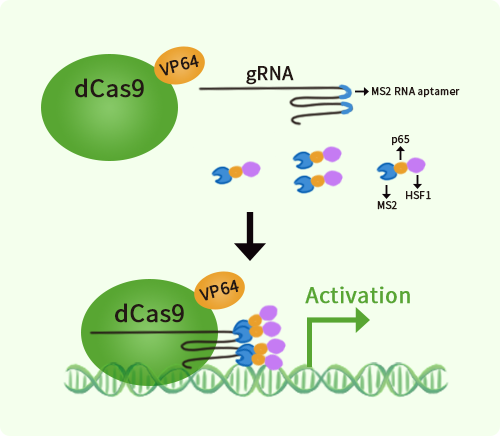
| OTI Disclaimer | These products are manufactured and supplied by OriGene under license from ERS. The kit is designed based on the best knowledge of CRISPRa SAM technology. The efficiency of the activation can be affected by many factors, including nucleosome occupancy status, chromatin structure and the gene expression level of the target, etc. |
| Shipping | Ambient |
| Reference Data | |
| Summary | Summary:Immunoglobulins recognize foreign antigens and initiate immune responses such as phagocytosis and the complement system. Each immunoglobulin molecule consists of two identical heavy chains and two identical light chains. This region represents the germline organization of the heavy chain locus. The locus includes V (variable), D (diversity), J (joining), and C (constant) segments. During B cell development, a recombination event at the DNA level joins a single D segment with a J segment; this partially rearranged D-J gene is then joined to a V segment. The rearranged V-D-J is then transcribed with the IGHM constant region; this transcript encodes a mu heavy chain. Later in development B cells generate V-D-J-Cmu-Cdelta pre-messenger RNA, which is alternatively spliced to encode either a mu or a delta heavy chain. Mature B cells in the lymph nodes undergo switch recombination, so that the V-D-J gene is brought in proximity to one of the IGHG, IGHA, or IGHE genes and each cell expresses either the gamma, alpha, or epsilon heavy chain. Recombination of many different V segments with several J segments provides a wide range of antigen recognition. Additional diversity is attained by junctional diversity, resulting from the random additional of nucleotides by terminal deoxynucleotidyltransferase, and by somatic hypermutation, which occurs during B cell maturation in the spleen and lymph nodes. The RefSeq represents the IGH locus from C57BL/6. Several V and D segments in C57BL/6 are known to be incapable of encoding a protein and are considered pseudogenes. provided by RefSeq, Jul 2008 |
Reviews


Documents
| Product Manuals |
| FAQs |
| SDS |
Resources
Citations
*Delivery time may vary from web posted schedule. Occasional delays may occur due to unforeseen
complexities in the preparation of your product. International customers may expect an additional 1-2 weeks
in shipping.
Related Products
- Price:
- Actual Price:
Welcome to OriGene AI!
I'm your AI-powered guide to everything OriGene.
Ask me anything:
- Product specs
- Ordering help
- Technical questions
- How to find exactly what your experiment needs
Prefer a live agent? Connect with us by clicking the green chat icon, as seen in the image below or email our team at custsupport@origene.com.
