
Mouse Wdfy3 activation kit by CRISPRa
SKU
GA209127
Wdfy3 CRISPRa kit - CRISPR gene activation of mouse WD repeat and FYVE domain containing 3
$1,657.00
4 Weeks*
Specifications
| Product Data | |
| Format | 3 gRNAs (5ug each), 1 scramble ctrl (10ug) and 1 enhancer vector (10ug) |
|---|---|
| Target Symbol | Wdfy3 |
| Locus ID | 72145 |
| Components |
GA209127G1, Wdfy3 gRNA vector 1 in pCas-Guide-GFP-CRISPRa GA209127G2, Wdfy3 gRNA vector 2 in pCas-Guide-GFP-CRISPRa GA209127G3, Wdfy3 gRNA vector 3 in pCas-Guide-GFP-CRISPRa 1 CRISPRa-Enhancer vector, SKU GE100056 1 CRISPRa scramble vector, SKU GE100077 |
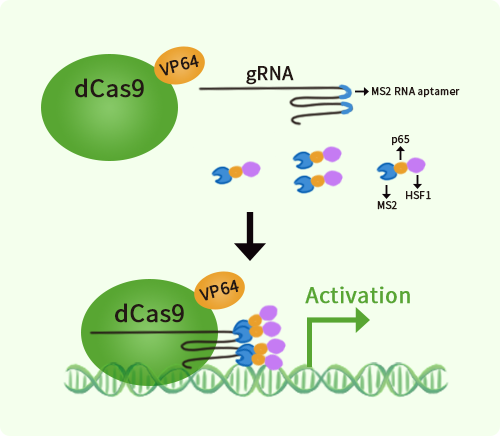
| OTI Disclaimer | These products are manufactured and supplied by OriGene under license from ERS. The kit is designed based on the best knowledge of CRISPRa SAM technology. The efficiency of the activation can be affected by many factors, including nucleosome occupancy status, chromatin structure and the gene expression level of the target, etc. |
| Shipping | Ambient |
| Reference Data | |
| RefSeq | NM_172882 |
| Synonyms | 2610509D04Rik; ALFY; AW319683; B930017C24; Bchs; BWF1; D5Ertd66e; Ggtb3; mKIAA0993; ZFYVE25 |
| Summary | Required for selective macroautophagy (aggrephagy). Acts as an adapter protein by linking specific proteins destined for degradation to the core autophagic machinery members, such as the ATG5-ATG12-ATG16L E3-like ligase, SQSTM1 and LC3. Involved in the formation and autophagic degradation of cytoplasmic ubiquitin-containing inclusions (p62 bodies, ALIS/aggresome-like induced structures) (By similarity). Important for normal brain development (PubMed:25198012, PubMed:27648578). Essential for the formation of axonal tracts throughout the brain and spinal cord, including the formation of the major forebrain commissures. Involved in the ability of neural cells to respond to guidance cues. Required for cortical neurons to respond to the trophic effects of netrin-1/NTN1 (PubMed:27648578). Regulates Wnt signaling through the removal of DVL3 aggregates, likely in an autophagy-dependent manner. This process may be important for the determination of brain size during embryonic development (By similarity). May regulate osteoclastogenesis by acting on the TNFSF11/RANKL - TRAF6 pathway (PubMed:27330028). After cytokinetic abscission, involved in midbody remnant degradation. In vitro strongly binds to phosphatidylinositol 3-phosphate (PtdIns3P) (By similarity).UniProtKB/Swiss-Prot Function |
Reviews


Documents
| Product Manuals |
| FAQs |
| SDS |
Resources
Citations
*Delivery time may vary from web posted schedule. Occasional delays may occur due to unforeseen
complexities in the preparation of your product. International customers may expect an additional 1-2 weeks
in shipping.
Related Products
- Price:
- Actual Price:
Welcome to OriGene AI!
I'm your AI-powered guide to everything OriGene.
Ask me anything:
- Product specs
- Ordering help
- Technical questions
- How to find exactly what your experiment needs
Prefer a live agent? Connect with us by clicking the green chat icon, as seen in the image below or email our team at custsupport@origene.com.
