
Mouse Nr1h4 activation kit by CRISPRa
SKU
GA203738
Nr1h4 CRISPRa kit - CRISPR gene activation of mouse nuclear receptor subfamily 1, group H, member 4
$1,657.00
4 Weeks*
Specifications
| Product Data | |
| Format | 3 gRNAs (5ug each), 1 scramble ctrl (10ug) and 1 enhancer vector (10ug) |
|---|---|
| Target Symbol | Nr1h4 |
| Locus ID | 20186 |
| Components |
GA203738G1, Nr1h4 gRNA vector 1 in pCas-Guide-GFP-CRISPRa GA203738G2, Nr1h4 gRNA vector 2 in pCas-Guide-GFP-CRISPRa GA203738G3, Nr1h4 gRNA vector 3 in pCas-Guide-GFP-CRISPRa 1 CRISPRa-Enhancer vector, SKU GE100056 1 CRISPRa scramble vector, SKU GE100077 |
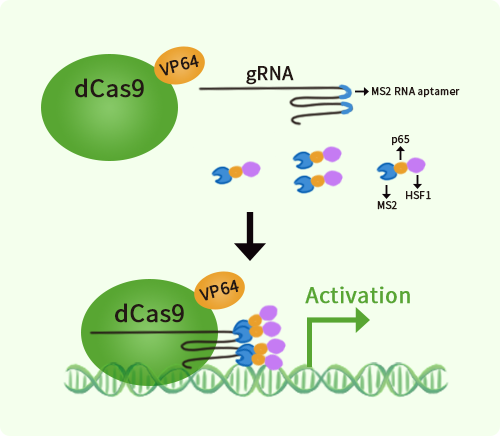
| OTI Disclaimer | These products are manufactured and supplied by OriGene under license from ERS. The kit is designed based on the best knowledge of CRISPRa SAM technology. The efficiency of the activation can be affected by many factors, including nucleosome occupancy status, chromatin structure and the gene expression level of the target, etc. |
| Shipping | Ambient |
| Reference Data | |
| RefSeq | NM_001163504, NM_001163700, NM_009108 |
| UniProt ID | Q60641 |
| Synonyms | AI957360; Fxr; HRR1; RIP14; Rxrip14 |
| Summary | Ligand-activated transcription factor. Receptor for bile acids (BAs) such as chenodeoxycholic acid (CDCA), lithocholic acid, deoxycholic acid (DCA) and allocholic acid (ACA). Plays a essential role in BA homeostasis through the regulation of genes involved in BA synthesis, conjugation and enterohepatic circulation. Also regulates lipid and glucose homeostasis and is involved in innate immune response (PubMed:11030617, PubMed:21383957, PubMed:22820415). The FXR-RXR heterodimer binds predominantly to farnesoid X receptor response elements (FXREs) containing two inverted repeats of the consensus sequence 5'-AGGTCA-3' in which the monomers are spaced by 1 nucleotide (IR-1) but also to tandem repeat DR1 sites with lower affinity, and can be activated by either FXR or RXR-specific ligands. It is proposed that monomeric nuclear receptors such as NR5A2/LRH-1 bound to coregulatory nuclear responsive element (NRE) halfsites located in close proximity to FXREs modulate transcriptional activity (PubMed:20091679, PubMed:20483916). In the liver activates transcription of the corepressor NR0B2 thereby indirectly inhibiting CYP7A1 and CYP8B1 (involved in BA synthesis) implicating at least in part histone demethylase KDM1A resulting in epigenomic repression, and SLC10A1/NTCP (involved in hepatic uptake of conjugated BAs). Activates transcription of the repressor MAFG (involved in regulation of BA synthesis) (PubMed:21383957, PubMed:25651182, PubMed:25545350). Activates transcription of SLC27A5/BACS and BAAT (involved in BA conjugation), ABCB11/BSEP (involved in bile salt export) by directly recruiting histone methyltransferase CARM1, and ABCC2/MRP2 (involved in secretion of conjugated BAs) and ABCB4 (involved in secretion of phosphatidylcholine in the small intestine) (PubMed:21383957). In ileal enterocytes activates FABP6/IBABP (involved in cytosolic transport), SLC51A/OSTA and SLC51B/OSTB (involved in secretion of conjugated BAs to the portal blood), and repressor NR0B2/SHP thereby indirectly inhibiting SLC10A2/ASBT (involved in BA uptake) (By similarity). In the intestine activates FGF15 expression and secretion leading to hepatic CYP7A1 repression; the function also involves the coordinated induction of hepatic KLB/beta-klotho expression (PubMed:16213224, PubMed:26505219). Transcriptional activation of FABP6/IBAP and SCD1 but not of ABCB11 is isoform-specific (PubMed:12393883). Regulates transcription of liver UGT2B4 and SULT2A1 involved in BA detoxification; binding to the UGT2B4 promoter seems to imply a monomeric transactivation independent of RXRA (By similarity). Modulates lipid homeostasis by activating liver NR0B2/SHP-mediated repression of SREBF1 isoform SREBP-1C (involved in de novo lipogenesis), expression of PLTP (involved in HDL formation), SCARB1 (involved in HDL hepatic uptake), APOE, APOC1, APOC4, VLDLR and SDC1 (involved in the hepatic uptake of LDL and IDL remnants), and inhibiting expression of MTTP (involved in VLDL assembly) (PubMed:12421815, PubMed:15146238). Increases expression of APOC2 (promoting lipoprotein lipase activity implicated in triglyceride clearance) (PubMed:11579204). Transrepresses APOA1 probably involving a monomeric competition with NR2A1 for binding to a DR1 element (PubMed:21804189). Also reduces triglyceride clearance by inhibiting expression of ANGPTL3 and APOC3 (both involved in inhibition of lipoprotein lipase) (PubMed:12891557, PubMed:15146238). Involved in glucose homeostasis by modulating hepatic gluconeogenesis through activation of NR0B2/SHP-mediated repression of respective genes. Modulates glycogen synthesis (inducing phosphorylation of glycogen synthase kinase-3). Modulates glucose-stimulated insulin secretion and is involved in insulin resistance (PubMed:15564327, PubMed:16446356, PubMed:16557297, PubMed:16410358, PubMed:20447400). Involved in intestinal innate immunity. Plays a role in protecting the distal small intestine against bacterial overgrowth and preservation of the epithelial barrier (PubMed:16473946, PubMed:21242261). Down- |
Reviews


Documents
| Product Manuals |
| FAQs |
| SDS |
Resources
Other Versions
| SKU | Description | Size | Price | |
|---|---|---|---|---|
| KN511197 | Nr1h4 - KN2.0, Mouse gene knockout kit via CRISPR, non-homology mediated. | 1 kit |
$1,657.00
|
|
Citations
*Delivery time may vary from web posted schedule. Occasional delays may occur due to unforeseen
complexities in the preparation of your product. International customers may expect an additional 1-2 weeks
in shipping.
Related Products
- Price:
- Actual Price:
Welcome to OriGene AI!
I'm your AI-powered guide to everything OriGene.
Ask me anything:
- Product specs
- Ordering help
- Technical questions
- How to find exactly what your experiment needs
Prefer a live agent? Connect with us by clicking the green chat icon, as seen in the image below or email our team at custsupport@origene.com.
