
Mouse Kcnk1 activation kit by CRISPRa
SKU
GA202275
Kcnk1 CRISPRa kit - CRISPR gene activation of mouse potassium channel, subfamily K, member 1
$1,657.00
4 Weeks*
Specifications
| Product Data | |
| Format | 3 gRNAs (5ug each), 1 scramble ctrl (10ug) and 1 enhancer vector (10ug) |
|---|---|
| Target Symbol | Kcnk1 |
| Locus ID | 16525 |
| Components |
GA202275G1, Kcnk1 gRNA vector 1 in pCas-Guide-GFP-CRISPRa GA202275G2, Kcnk1 gRNA vector 2 in pCas-Guide-GFP-CRISPRa GA202275G3, Kcnk1 gRNA vector 3 in pCas-Guide-GFP-CRISPRa 1 CRISPRa-Enhancer vector, SKU GE100056 1 CRISPRa scramble vector, SKU GE100077 |
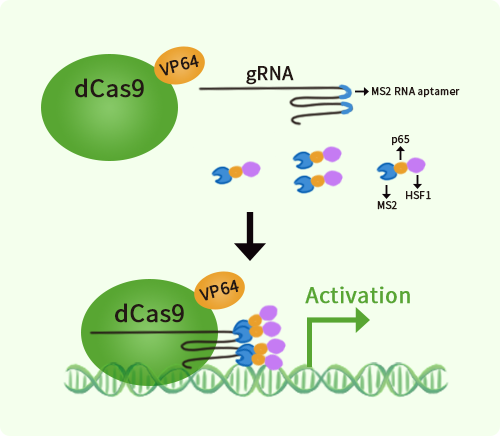
| OTI Disclaimer | These products are manufactured and supplied by OriGene under license from ERS. The kit is designed based on the best knowledge of CRISPRa SAM technology. The efficiency of the activation can be affected by many factors, including nucleosome occupancy status, chromatin structure and the gene expression level of the target, etc. |
| Shipping | Ambient |
| Reference Data | |
| RefSeq | NM_008430 |
| UniProt ID | O08581 |
| Synonyms | AI788889; TWIK-1 |
| Summary | Ion channel that contributes to passive transmembrane potassium transport and to the regulation of the resting membrane potential in brain astrocytes, but also in kidney and in other tissues (PubMed:16847696, PubMed:22431633, PubMed:24368895). Forms dimeric channels through which potassium ions pass in accordance with their electrochemical gradient. The channel is selective for K(+) ions at physiological potassium concentrations and at neutral pH, but becomes permeable to Na(+) at subphysiological K(+) levels and upon acidification of the extracellular medium. The homodimer has very low potassium channel activity, when expressed in heterologous systems, and can function as weakly inward rectifying potassium channel (PubMed:9013852, PubMed:24496152). Channel activity is modulated by activation of serotonin receptors (PubMed:24368895). Heterodimeric channels containing KCNK1 and KCNK2 have much higher activity, and may represent the predominant form in astrocytes (PubMed:24496152). Heterodimeric channels containing KCNK1 and KCNK3 or KCNK9 have much higher activity. Heterodimeric channels formed by KCNK1 and KCNK9 may contribute to halothane-sensitive currents (By similarity). Mediates outward rectifying potassium currents in dentate gyrus granule cells and contributes to the regulation of their resting membrane potential (PubMed:25406588). Contributes to the regulation of action potential firing in dentate gyrus granule cells and down-regulates their intrinsic excitability (PubMed:25406588). In astrocytes, the heterodimer formed by KCNK1 and KCNK2 is required for rapid glutamate release in response to activation of G-protein coupled receptors, such as F2R and CNR1 (PubMed:24496152). Required for normal ion and water transport in the kidney (PubMed:16025300). Contributes to the regulation of the resting membrane potential of pancreatic beta cells (PubMed:22431633). The low channel activity of homodimeric KCNK1 may be due to sumoylation. The low channel activity may be due to rapid internalization from the cell membrane and retention in recycling endosomes (PubMed:15540117).UniProtKB/Swiss-Prot Function |
Reviews


Documents
| Product Manuals |
| FAQs |
| SDS |
Resources
Other Versions
| SKU | Description | Size | Price | |
|---|---|---|---|---|
| KN508663 | Kcnk1 - KN2.0, Mouse gene knockout kit via CRISPR, non-homology mediated. | 1 kit |
$1,657.00
|
|
Citations
*Delivery time may vary from web posted schedule. Occasional delays may occur due to unforeseen
complexities in the preparation of your product. International customers may expect an additional 1-2 weeks
in shipping.
Related Products
- Price:
- Actual Price:
Welcome to OriGene AI!
I'm your AI-powered guide to everything OriGene.
Ask me anything:
- Product specs
- Ordering help
- Technical questions
- How to find exactly what your experiment needs
Prefer a live agent? Connect with us by clicking the green chat icon, as seen in the image below or email our team at custsupport@origene.com.
