
Human IFNL4 activation kit by CRISPRa
SKU
GA119461
IFNL4 CRISPRa kit - CRISPR gene activation of human interferon lambda 4 (gene/pseudogene)
$1,657.00
4 Weeks*
Specifications
| Product Data | |
| Format | 3 gRNAs (5ug each), 1 scramble ctrl (10ug) and 1 enhancer vector (10ug) |
|---|---|
| Target Symbol | IFNL4 |
| Locus ID | 101180976 |
| Components |
GA119461G1, IFNL4 gRNA vector 1 in pCas-Guide-GFP-CRISPRa GA119461G2, IFNL4 gRNA vector 2 in pCas-Guide-GFP-CRISPRa GA119461G3, IFNL4 gRNA vector 3 in pCas-Guide-GFP-CRISPRa 1 CRISPRa-Enhancer vector, SKU GE100056 1 CRISPRa scramble vector, SKU GE100077 |
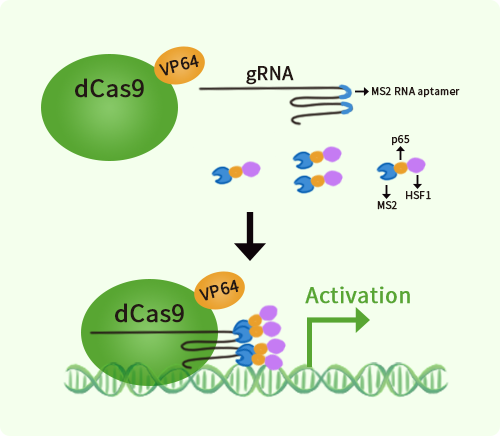
| OTI Disclaimer | These products are manufactured and supplied by OriGene under license from ERS. The kit is designed based on the best knowledge of CRISPRa SAM technology. The efficiency of the activation can be affected by many factors, including nucleosome occupancy status, chromatin structure and the gene expression level of the target, etc. |
| Shipping | Ambient |
| Reference Data | |
| RefSeq | NM_001276254, NR_074079 |
| UniProt ID | K9M1U5 |
| Synonyms | IFNAN |
| Summary | This gene is a polymorphic pseudogene which, in some humans, encodes the interferon (IFN) lambda 4 protein. Humans are polymorphic for the dinucleotide TT/deltaG allele. Compared to the ancestral state in non-human primates, the TT allele produces a frameshift in the coding region of this gene which is predicted to induce nonsense-mediated mRNA decay. This allele, and an allele in the first intron of this gene, have experienced a rapid increase in frequency and show indications of positive selection. The ancestral states of these alleles are associated with an impaired ability to clear hepatitis C virus. This gene, like other type III interferons (IFNs), interacts with the IFN lambda receptor complex (IFNLR) whose signaling is generally restricted to epithelial cells. This gene resides in a cluster of four type III IFN genes and at least two pseudogenes on chromosome 19q13.2. In general, interferons are produced in response to viral infection and block viral replication and propagation to uninfected cells by activating the JAK-STAT pathway and up-regulating antiviral genes. Multiple alternatively spliced transcripts have been described for this gene but their biological validity and protein coding status is still being ascertained. provided by RefSeq, May 2017 |
Reviews


Documents
| Product Manuals |
| FAQs |
| SDS |
Resources
Citations
*Delivery time may vary from web posted schedule. Occasional delays may occur due to unforeseen
complexities in the preparation of your product. International customers may expect an additional 1-2 weeks
in shipping.
Related Products
- Price:
- Actual Price:
Welcome to OriGene AI!
I'm your AI-powered guide to everything OriGene.
Ask me anything:
- Product specs
- Ordering help
- Technical questions
- How to find exactly what your experiment needs
Prefer a live agent? Connect with us by clicking the green chat icon, as seen in the image below or email our team at custsupport@origene.com.
