
pCMV6-AC-DDK-His Mammalian Expression Vector

$670.00
In Stock*
Specifications
| Product Data | |
| C-Tag | DDK-His |
|---|---|
| E. coli Selection | Ampicillin (100 ug/mL) |
| Mammalian Cell Selection | Neomycin |
| Expression Promoter | CMV |
| Features |
|
| Download Vector Sequence | |
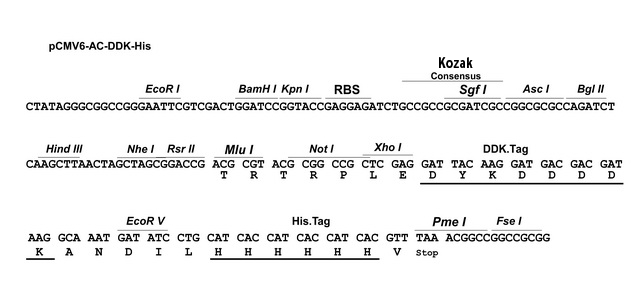
| Schematic of the multiple cloning sites |
|
| Shipping | Ambient |
Reviews


Documents
Resources
Citations
Engineering polysialic acid on Schwann cells using polysialyltransferase gene transfer or purified enzyme exposure for spinal cord injury transplantation
Pearse, Rao, Morales et al
Neurosci Lett (2021) 748, 135690 DOI: 10.1016/j.neulet.2021.135690
Pearse, Rao, Morales et al
Neurosci Lett (2021) 748, 135690 DOI: 10.1016/j.neulet.2021.135690
Cited by 5
AI Summary: In this study, OriGene’s TrueORF cDNA clone for mouse ST8SIA4 (Cat# MR209993) was used to generate lentiviral vectors for polysialyltransferase gene transfer, enabling the researchers to induce polysialic acid expression on Schwann cells and assess its effects on migration and axon growth after spinal cord injury transplantation.
Quantitative glycoproteomics reveals new classes of STT3A- and STT3B-dependent N-glycosylation sites
Cherepanova, Venev, Leszyk et al
J. Cell Biol. (2019) 218 (8), 2782-2796 DOI: 10.1083/jcb.201904004
Cherepanova, Venev, Leszyk et al
J. Cell Biol. (2019) 218 (8), 2782-2796 DOI: 10.1083/jcb.201904004
AI Summary: OriGene's pCMV6-AC-DDK-His vector was used to clone and express GRP94 and KDEL2 coding sequences, enabling the study of glycosylation patterns in the analyzed proteins.
Snippet: A full-length GRP94-verified clone was purchased from the Human Clone Collection at University of Massachusetts Medical School (ID 6165138). A KDEL2 clone was purchased from Transomics (ID 5266665). The coding sequences were amplified by PCR and cloned into the pCMV6-AC-DDK-His vector (Origene)
DC2 and KCP2 mediate the interaction between the oligosaccharyltransferase and the ER translocon
Shrimal, Cherepanova, Gilmore
J. Cell Biol. (2017)
Shrimal, Cherepanova, Gilmore
J. Cell Biol. (2017)
AI Summary: OriGene's pCMV6-AC-DDK-His vector was used for cloning amplification products, facilitating the expression and analysis of proteins involved in the study of interactions between the oligosaccharyltransferase and the ER translocon.
Snippet: The amplification products were then cloned into a pCMV6-AC-DDK-His vector (OriGene) with a stop codon inserted upstream of the DDK-His coding sequence
Characterization of the human T cell response to in vitro CD27 costimulation with varlilumab
Ramakrishna, Sundarapandiyan, Zhao et al
J Immunother Cancer (2015) 3, 37 DOI: 10.1186/s40425-015-0080-2
Ramakrishna, Sundarapandiyan, Zhao et al
J Immunother Cancer (2015) 3, 37 DOI: 10.1186/s40425-015-0080-2
Cited by 62
AI Summary: In this study, OriGene's Human CD27 (TNFRSF7) cDNA clone (Cat# SC119755) was used to characterize the molecular and functional effects of varlilumab-mediated CD27 costimulation in human T cells.
Regulation of NEIL1 protein abundance by RAD9 is important for efficient base excision repair
Panigrahi, Hopkins, Lieberman
Nucleic Acids Res. (2015)
Panigrahi, Hopkins, Lieberman
Nucleic Acids Res. (2015)
Cited by 16
Reduced expression of the oligosaccharyltransferase exacerbates protein hypoglycosylation in cells lacking the fully assembled oligosaccharide donor
Shrimal, Gilmore
Glycobiology (2015)
Shrimal, Gilmore
Glycobiology (2015)
Cited by 16
AI Summary: In this study, OriGene’s pCMV6-AC-DDK-His vector was used to express human prosaposin and progranulin, enabling the authors to investigate how altered glycosylation affects these proteins in cells with defects in the oligosaccharide donor and OST subunit expression.
Snippet: Human prosaposin and progranulin were amplified from cDNA clones (Thermo Scientific, Pittsburg, PA, USA) and inserted into the pCMV6-AC-DDK-His vector (OriGene, ... (Origene) and inserted into pCDNA-V5H6. A common polymorphism that can cause a mild ... Cite SaveSaving
Showing 1-6 of 12 papers.
Powered by BizGenius
*Delivery time may vary from web posted schedule. Occasional delays may occur due to unforeseen
complexities in the preparation of your product. International customers may expect an additional 1-2 weeks
in shipping.
Related Products
- Price:
- Actual Price:
Welcome to OriGene AI!
I'm your AI-powered guide to everything OriGene.
Ask me anything:
- Product specs
- Ordering help
- Technical questions
- How to find exactly what your experiment needs
Prefer a live agent? Connect with us by clicking the green chat icon, as seen in the image below or email our team at custsupport@origene.com.
