
Bag6 Mouse shRNA Plasmid (Locus ID 224727)
SKU
TL515195
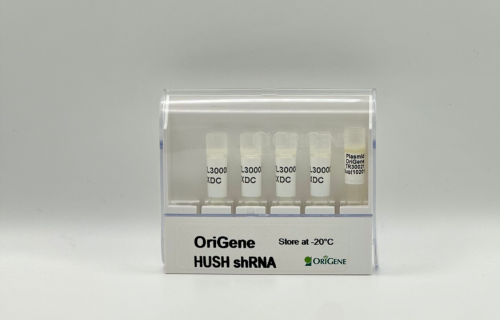
Bag6 - Mouse, 4 unique 29mer shRNA constructs in lentiviral GFP vector, 5µg of each construct provided
$1,013.00
2 Weeks*
Specifications
| Product Data | |
| Locus ID | 224727 |
|---|---|
| Synonyms | 2410045D21Rik; AA408914; BAG-6; Bat3; D17H6S52E; G3; Scythe |
| Vector | pGFP-C-shLenti |
| E. coli Selection | Chloramphenicol (34 ug/ml) |
| Mammalian Cell Selection | Puromycin |
| Format | Lentiviral plasmids |
| Components | Bag6 - Mouse, 4 unique 29mer shRNA constructs in lentiviral GFP vector(Gene ID = 224727). 5µg purified plasmid DNA per construct29-mer scrambled shRNA cassette in pGFP-C-shLenti Vector, TR30021, included for free. |
| RefSeq | NM_001252468, NM_001252469, NM_057171, NM_057171.1, NM_057171.2, NM_001252469.1, NM_001252468.1, BC026647, BC030296, BC037051, BC048137, BM951977, NM_001252469.2, NM_057171.3, NM_001252468.2 |
| UniProt ID | Q9Z1R2 |
| Summary | ATP-independent molecular chaperone preventing the aggregation of misfolded and hydrophobic patches-containing proteins (PubMed:18056262, PubMed:18678708, PubMed:20713601). Functions as part of a cytosolic protein quality control complex, the BAG6/BAT3 complex, which maintains these client proteins in a soluble state and participates to their proper delivery to the endoplasmic reticulum or alternatively can promote their sorting to the proteasome where they undergo degradation (PubMed:20713601). The BAG6/BAT3 complex is involved in the post-translational delivery of tail-anchored/type II transmembrane proteins to the endoplasmic reticulum membrane. Recruited to ribosomes, it interacts with the transmembrane region of newly synthesized tail-anchored proteins and together with SGTA and ASNA1 mediates their delivery to the endoplasmic reticulum. Client proteins that cannot be properly delivered to the endoplasmic reticulum are ubiquitinated by RNF126, an E3 ubiquitin-protein ligase associated with BAG6 and are sorted to the proteasome. SGTA which prevents the recruitment of RNF126 to BAG6 may negatively regulate the ubiquitination and the proteasomal degradation of client proteins. Similarly, the BAG6/BAT3 complex also functions as a sorting platform for proteins of the secretory pathway that are mislocalized to the cytosol either delivering them to the proteasome for degradation or to the endoplasmic reticulum. The BAG6/BAT3 complex also plays a role in the endoplasmic reticulum-associated degradation (ERAD), a quality control mechanism that eliminates unwanted proteins of the endoplasmic reticulum through their retrotranslocation to the cytosol and their targeting to the proteasome. It maintains these retrotranslocated proteins in an unfolded yet soluble state condition in the cytosol to ensure their proper delivery to the proteasome (By similarity). BAG6 is also required for selective ubiquitin-mediated degradation of defective nascent chain polypeptides by the proteasome. In this context, it may participate to the production of antigenic peptides and play a role in antigen presentation in immune response (PubMed:20713601). BAG6 is also involved in endoplasmic reticulum stress-induced pre-emptive quality control, a mechanism that selectively attenuates the translocation of newly synthesized proteins into the endoplasmic reticulum and reroutes them to the cytosol for proteasomal degradation. BAG6 may ensure the proper degradation of these proteins and thereby protects the endoplasmic reticulum from protein overload upon stress (By similarity). By inhibiting the polyubiquitination and subsequent proteasomal degradation of HSPA2 it may also play a role in the assembly of the synaptonemal complex during spermatogenesis (PubMed:18678708). Also positively regulates apoptosis by interacting with and stabilizing the proapoptotic factor AIFM1 (PubMed:18056262). By controlling the steady-state expression of the IGF1R receptor, indirectly regulates the insulin-like growth factor receptor signaling pathway (By similarity).UniProtKB/Swiss-Prot Function |
| shRNA Design | These shRNA constructs were designed against multiple splice variants at this gene locus. To be certain that your variant of interest is targeted, please contact techsupport@origene.com. If you need a special design or shRNA sequence, please utilize our custom shRNA service. |
| Storage | Store at -20°C |
| Shipping | Ambient |
Reviews


Documents
Resources
Citations
Down-regulation of HLA-B-associated transcript 3 impairs the tumoricidal effect of natural killer cells through promoting the T cell immunoglobulin and mucin domain-containing-3 signaling in a mouse head and neck squamous cell carcinoma model
Yang, Xiang, Zhu et al
Immunobiology (2021)
Yang, Xiang, Zhu et al
Immunobiology (2021)
Cited by 7
AI Summary: OriGene’s mouse BAT3 shRNA lentiviral particles (Cat# TL515195V) and corresponding scramble control were used in this study to specifically down-regulate BAT3 expression and investigate its role in natural killer cell-mediated tumoricidal activity.
Snippet: staining with the PE anti-BAT3 antibody. The mouse BAT3 shRNA lentiviral particles (Cat# TL515195V) and corresponding scramble control were purchased from OriGene Technologies. Lentiviral particles were added into NK;The mouse BAT3 shRNA lentiviral particles (Cat# TL515195V) and corresponding scramble control were purchased from OriGene Technologies
Showing 1-1 of 1 papers.
Powered by BizGenius
*Delivery time may vary from web posted schedule. Occasional delays may occur due to unforeseen
complexities in the preparation of your product. International customers may expect an additional 1-2 weeks
in shipping.
Related Products
- Price:
- Actual Price:
Welcome to OriGene AI!
I'm your AI-powered guide to everything OriGene.
Ask me anything:
- Product specs
- Ordering help
- Technical questions
- How to find exactly what your experiment needs
Prefer a live agent? Connect with us by clicking the green chat icon, as seen in the image below or email our team at custsupport@origene.com.
