
Fzd4 Mouse shRNA Plasmid (Locus ID 14366)
SKU
TL500740
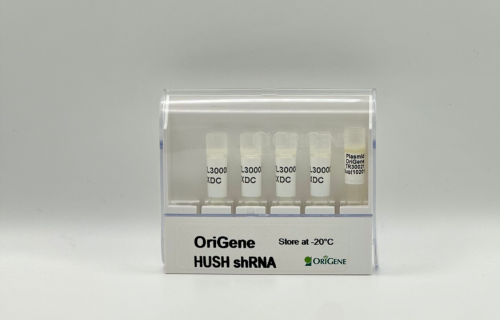
Fzd4 - Mouse, 4 unique 29mer shRNA constructs in lentiviral GFP vector, 5µg of each construct provided
$1,013.00
2 Weeks*
Specifications
| Product Data | |
| Locus ID | 14366 |
|---|---|
| Synonyms | Fz4 |
| Vector | pGFP-C-shLenti |
| E. coli Selection | Chloramphenicol (34 ug/ml) |
| Mammalian Cell Selection | Puromycin |
| Format | Lentiviral plasmids |
| Components | Fzd4 - Mouse, 4 unique 29mer shRNA constructs in lentiviral GFP vector(Gene ID = 14366). 5µg purified plasmid DNA per construct29-mer scrambled shRNA cassette in pGFP-C-shLenti Vector, TR30021, included for free. |
| RefSeq | BC015256, NM_008055, NM_008055.1, NM_008055.2, NM_008055.3, NM_008055.4 |
| UniProt ID | Q61088 |
| Summary | Receptor for Wnt proteins. Most of frizzled receptors are coupled to the beta-catenin (CTNNB1) canonical signaling pathway, which leads to the activation of disheveled proteins, inhibition of GSK-3 kinase, nuclear accumulation of beta-catenin (CTNNB1) and activation of Wnt target genes. Plays a critical role in retinal vascularization by acting as a receptor for Wnt proteins and norrin (NDP). In retina, it can be both activated by Wnt protein-binding, but also by a Wnt-independent signaling via binding of norrin (NDP), promoting in both cases beta-catenin (CTNNB1) accumulation and stimulation of LEF/TCF-mediated transcriptional programs. A second signaling pathway involving PKC and calcium fluxes has been seen for some family members, but it is not yet clear if it represents a distinct pathway or if it can be integrated in the canonical pathway, as PKC seems to be required for Wnt-mediated inactivation of GSK-3 kinase. Both pathways seem to involve interactions with G-proteins. May be involved in transduction and intercellular transmission of polarity information during tissue morphogenesis and/or in differentiated tissues. Activation by Wnt5A stimulates PKC activity via a G-protein-dependent mechanism.UniProtKB/Swiss-Prot Function |
| shRNA Design | These shRNA constructs were designed against multiple splice variants at this gene locus. To be certain that your variant of interest is targeted, please contact techsupport@origene.com. If you need a special design or shRNA sequence, please utilize our custom shRNA service. |
| Storage | Store at -20°C |
| Shipping | Ambient |
Reviews


Documents
Resources
Citations
Wnt5a/FZD4 Mediates the Mechanical Stretch-Induced Osteogenic Differentiation of Bone Mesenchymal Stem Cells
Gu, Tian, Zhang et al
Cell. Physiol. Biochem. (2018) 48 (1), 215-226 DOI: 10.1159/000491721
Gu, Tian, Zhang et al
Cell. Physiol. Biochem. (2018) 48 (1), 215-226 DOI: 10.1159/000491721
AI Summary: OriGene products contributed to this study by providing the pLenti-C-Myc-FZD4 shRNA vectors and empty control vectors (scram-shRNA), which were used to knock down FZD4 expression and investigate its role in mechanical stretch-induced osteogenic differentiation of bone mesenchymal stem cells.
Showing 1-1 of 1 papers.
Powered by BizGenius
*Delivery time may vary from web posted schedule. Occasional delays may occur due to unforeseen
complexities in the preparation of your product. International customers may expect an additional 1-2 weeks
in shipping.
Related Products
- Price:
- Actual Price:
Welcome to OriGene AI!
I'm your AI-powered guide to everything OriGene.
Ask me anything:
- Product specs
- Ordering help
- Technical questions
- How to find exactly what your experiment needs
Prefer a live agent? Connect with us by clicking the green chat icon, as seen in the image below or email our team at custsupport@origene.com.
