
Ctcf Mouse shRNA Plasmid (Locus ID 13018)
SKU
TL500456
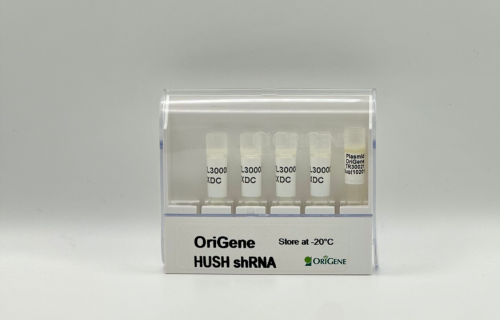
Ctcf - Mouse, 4 unique 29mer shRNA constructs in lentiviral GFP vector, 5µg of each construct provided
$1,013.00
In Stock*
Specifications
| Product Data | |
| Locus ID | 13018 |
|---|---|
| Synonyms | AW108038 |
| Vector | pGFP-C-shLenti |
| E. coli Selection | Chloramphenicol (34 ug/ml) |
| Mammalian Cell Selection | Puromycin |
| Format | Lentiviral plasmids |
| Components | Ctcf - Mouse, 4 unique 29mer shRNA constructs in lentiviral GFP vector(Gene ID = 13018). 5µg purified plasmid DNA per construct29-mer scrambled shRNA cassette in pGFP-C-shLenti Vector, TR30021, included for free. |
| RefSeq | BC046398, BC049131, BC058240, NM_007794, NM_181322, NM_001358924, NM_181322.1, NM_181322.3, NM_007794.1, BC009129, BC024382, BC037456 |
| UniProt ID | Q61164 |
| Summary | Chromatin binding factor that binds to DNA sequence specific sites. Involved in transcriptional regulation by binding to chromatin insulators and preventing interaction between promoter and nearby enhancers and silencers. Acts as transcriptional repressor binding to promoters of vertebrate MYC gene and BAG1 gene. Also binds to the PLK and PIM1 promoters. Acts as a transcriptional activator of APP. Regulates APOA1/C3/A4/A5 gene cluster and controls MHC class II gene expression. Plays an essential role in oocyte and preimplantation embryo development by activating or repressing transcription. Seems to act as tumor suppressor. Plays a critical role in the epigenetic regulation. Participates in the allele-specific gene expression at the imprinted IGF2/H19 gene locus. On the maternal allele, binding within the H19 imprinting control region (ICR) mediates maternally inherited higher-order chromatin conformation to restrict enhancer access to IGF2. Plays a critical role in gene silencing over considerable distances in the genome. Preferentially interacts with unmethylated DNA, preventing spreading of CpG methylation and maintaining methylation-free zones. Inversely, binding to target sites is prevented by CpG methylation. Plays an important role in chromatin remodeling. Can dimerize when it is bound to different DNA sequences, mediating long-range chromatin looping (By similarity). Mediates interchromosomal association between IGF2/H19 and WSB1/NF1 and may direct distant DNA segments to a common transcription factory. Causes local loss of histone acetylation and gain of histone methylation in the beta-globin locus, without affecting transcription. When bound to chromatin, it provides an anchor point for nucleosomes positioning. Seems to be essential for homologous X-chromosome pairing. May participate with Tsix in establishing a regulatable epigenetic switch for X chromosome inactivation. May play a role in preventing the propagation of stable methylation at the escape genes from X-inactivation. Involved in sister chromatid cohesion. Associates with both centromeres and chromosomal arms during metaphase and required for cohesin localization to CTCF sites. Regulates asynchronous replication of IGF2/H19. Plays a role in the recruitment of CENPE to the pericentromeric/centromeric regions of the chromosome during mitosis (By similarity).UniProtKB/Swiss-Prot Function |
| shRNA Design | These shRNA constructs were designed against multiple splice variants at this gene locus. To be certain that your variant of interest is targeted, please contact techsupport@origene.com. If you need a special design or shRNA sequence, please utilize our custom shRNA service. |
| Storage | Store at -20°C |
| Shipping | Ambient |
Reviews


Documents
Resources
Citations
*Delivery time may vary from web posted schedule. Occasional delays may occur due to unforeseen
complexities in the preparation of your product. International customers may expect an additional 1-2 weeks
in shipping.
Related Products
- Price:
- Actual Price:
Welcome to OriGene AI!
I'm your AI-powered guide to everything OriGene.
Ask me anything:
- Product specs
- Ordering help
- Technical questions
- How to find exactly what your experiment needs
Prefer a live agent? Connect with us by clicking the green chat icon, as seen in the image below or email our team at custsupport@origene.com.
