
Stt3b Mouse siRNA Oligo Duplex (Locus ID 68292)
$518.00
3 Weeks*
Specifications
| Product Data | |
| Purity | HPLC purified |
|---|---|
| Quality Control | Tested by ESI-MS |
| Sequences | Available with shipment |
| Components |
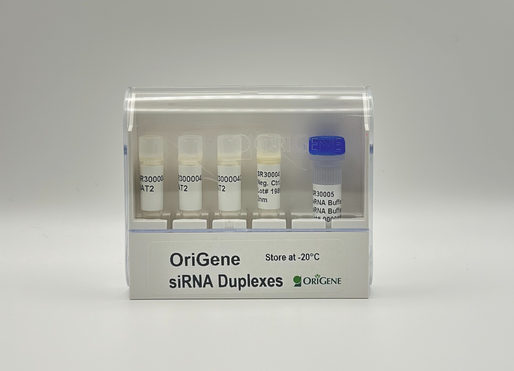
Stt3b (Mouse) - 3 unique 27mer siRNA duplexes - 2 nmol each (Locus ID 68292)Included - SR30004, Trilencer-27 Universal Scrambled Negative Control siRNA Duplex - 2 nmolIncluded - SR30005, RNAse free siRNA Duplex Resuspension Buffer - 2 ml
|
| Stability | One year from date of shipment when stored at -20°C. |
| Shipping | Ambient |
| # of Transfections | Approximately 330 transfections/2nmol in 24-well plate under optimized conditions (final conc. 10 nM). |
| Note | Single siRNA duplex (10nmol) can be ordered. |
| Reference Data | |
| RefSeq | NM_024222 |
| UniProt ID | Q3TDQ1 |
| Synonyms | 1300006C19Rik; Simp |
| Summary | Catalytic subunit of the oligosaccharyl transferase (OST) complex that catalyzes the initial transfer of a defined glycan (Glc(3)Man(9)GlcNAc(2) in eukaryotes) from the lipid carrier dolichol-pyrophosphate to an asparagine residue within an Asn-X-Ser/Thr consensus motif in nascent polypeptide chains, the first step in protein N-glycosylation. N-glycosylation occurs cotranslationally and the complex associates with the Sec61 complex at the channel-forming translocon complex that mediates protein translocation across the endoplasmic reticulum (ER). All subunits are required for a maximal enzyme activity. This subunit contains the active site and the acceptor peptide and donor lipid-linked oligosaccharide (LLO) binding pockets (By similarity). STT3B is present in a small subset of OST complexes and mediates both cotranslational and post-translational N-glycosylation of target proteins: STT3B-containing complexes are required for efficient post-translational glycosylation and while they are less competent than STT3A-containing complexes for cotranslational glycosylation, they have the ability to mediate glycosylation of some nascent sites that are not accessible for STT3A. STT3B-containing complexes also act post-translationally and mediate modification of skipped glycosylation sites in unfolded proteins. Plays a role in ER-associated degradation (ERAD) pathway that mediates ubiquitin-dependent degradation of misfolded endoplasmic reticulum proteins by mediating N-glycosylation of unfolded proteins, which are then recognized by the ERAD pathway and targeted for degradation (By similarity).UniProtKB/Swiss-Prot Function |
| Performance Guaranteed | OriGene guarantees that at least two of the three Dicer-Substrate duplexes in the kit will provide at least 70% or more knockdown of the target mRNA when used at 10 nM concentration by quantitative RT-PCR when the TYE-563 fluorescent transfection control duplex (cat# SR30002) indicates that >90% of the cells have been transfected and the HPRT positive control (cat# SR30003) provides 90% knockdown efficiency. For non-conforming siRNA, requests for replacement product must be made within ninety (90) days from the date of delivery of the siRNA kit. To arrange for a free replacement with newly designed duplexes, please contact Technical Services at techsupport@origene.com. Please provide your data indicating the transfection efficiency and measurement of gene expression knockdown compared to the scrambled siRNA control (quantitative RT-PCR data required). |
Reviews


Documents
| Product Manuals |
| FAQs |
| SDS |
Resources
Citations
*Delivery time may vary from web posted schedule. Occasional delays may occur due to unforeseen
complexities in the preparation of your product. International customers may expect an additional 1-2 weeks
in shipping.
Related Products
- Price:
- Actual Price:
Welcome to OriGene AI!
I'm your AI-powered guide to everything OriGene.
Ask me anything:
- Product specs
- Ordering help
- Technical questions
- How to find exactly what your experiment needs
Prefer a live agent? Connect with us by clicking the green chat icon, as seen in the image below or email our team at custsupport@origene.com.
