
AAV Serotyping Kit
The Importance of AAV Serotyping
Each AAV serotype exhibits unique characteristics, including tissue tropism and transduction efficiency, making serotype selection a critical factor in the success of gene delivery. When handling a new cell type or tissue where the optimal serotype is unknown, serotyping kits provide a solution, allowing you to test each serotype's transduction efficiency before starting your experiment.
OriGene offers AAV serotyping kits that enable researchers to select the most appropriate serotype for their specific research or therapeutic applications.
Key Features and Benefits
- Ultra-Purified Particles: The kit includes ultra-purified AAV viral particles, ensuring high-quality and consistent particles for gene delivery both in vitro & in vivo.
- Guaranteed High Titers: OriGene guarantees viral titers of >1013 GC/mL, providing researchers with ample material for efficient gene transduction.
- GFP Tagged: The GFP tag in each particles allows for easy visualization of transduction.
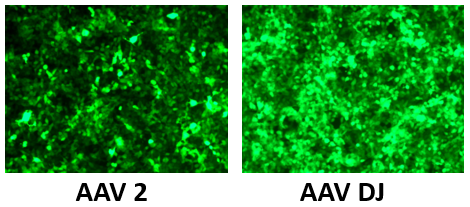 Figure 1: In vitro transduction efficiency of HEK293T cell line with different AAV serotypes. This image shows that AAV DJ is more efficient than AAV 2 for gene delivery in HEK293T cells.
| SKU | Name | Description | Cart |
|---|---|---|---|
| CV500001 | AAV Serotyping Kit I | This kit contains pre-made AAV-2, AAV-5, AAV-6, AAV-8, and AAV-9 control particles for testing each serotype's infection efficiency in your desired cell type. | |
| CV500002 | AAV Serotyping Kit II | This kit contains pre-made AAV-1, AAV-3, AAV-7, AAV-rh.10, AAV-DJ, and AAV-PHP.eB control particles for testing each serotypes infection efficiency in your desired cell type. |
| Name | Description | Catalog # |
|---|---|---|
| AAV Serotyping Kit I | This kit contains pre-made AAV-2, AAV-5, AAV-6, AAV-8, and AAV-9 control particles for testing each serotype's infection efficiency in your desired cell type. | |
| AAV Serotyping Kit II | This kit contains pre-made AAV-1, AAV-3, AAV-7, AAV-rh.10, AAV-DJ, and AAV-PHP.eB control particles for testing each serotypes infection efficiency in your desired cell type. |
AAV Serotype Selection Guide
Different AAV serotypes exhibit varying transduction efficiencies across different cell types. The table below provides the selection guide for in vitro and in vivo applications1.
Note: The numbers in the table are normalized to the infectivity rate of AAV-2. AAV-2 = 100. ND = Not Determined
| Cell Line | AAV-1 | AAV-2 | AAV-3 | AAV-4 | AAV-5 | AAV-6 | AAV-8 | AAV-9 | AAV-DJ | AAV-DJ/8 |
|---|---|---|---|---|---|---|---|---|---|---|
| Huh-7 | 13 | 100 | 2.5 | 0.0 | 0.1 | 10 | 0.7 | 0.0 | 500 | 0.2 |
| HEK293 | 25 | 100 | 2.5 | 0.1 | 0.1 | 5 | 0.7 | 0.1 | 500 | 0.3 |
| HeLa | 3 | 100 | 2.0 | 0.1 | 6.7 | 1 | 0.2 | 0.1 | 667 | 0.2 |
| HepG2 | 3 | 100 | 16.7 | 0.3 | 1.7 | 5 | 0.3 | ND | 1250 | 0.5 |
| Hep1A | 20 | 100 | 0.2 | 1.0 | 0.1 | 1 | 0.2 | 0.0 | 400 | 0.1 |
| 911 | 17 | 100 | 11 | 0.2 | 0.1 | 17 | 0.1 | ND | 500 | 0.0 |
| CHO | 100 | 100 | 14 | 1.4 | 333 | 50 | 10 | 1.0 | 25000 | 5.0 |
| COS | 33 | 100 | 33 | 3.3 | 5.0 | 14 | 2.0 | 0.5 | 500 | 0.3 |
| MeWo | 10 | 100 | 20 | 0.3 | 6.7 | 10 | 1.0 | 0.2 | 2857 | 1.0 |
| NIH3T3 | 10 | 100 | 2.9 | 2.9 | 0.3 | 10 | 0.3 | ND | 500 | 0.1 |
| A549 | 14 | 100 | 20 | ND | 0.5 | 10 | 0.5 | 0.1 | 1000 | 0.1 |
| HT1180 | 20 | 100 | 10 | 0.1 | 0.3 | 33 | 0.5 | 0.1 | 333 | 0.2 |
| Monocytes | 1111 | 100 | ND | ND | 125 | 1429 | ND | ND | 100 | ND |
| Immature DC | 2500 | 100 | ND | ND | 222 | 2857 | ND | ND | 200 | ND |
| Mature DC | 2222 | 100 | ND | ND | 333 | 3333 | ND | ND | 100 | ND |
1. Grimm D, Lee JS, Wang L, et al. In vitro and in vivo gene therapy vector evolution via multispecies interbreeding and retargeting of adeno-associated viruses. J Virol. 2008;82(12):5887-5911. doi:10.1128/JVI.00254-08
