



 Germany
 Japan
Japan
 United Kingdom
 China
China
Untagged Expression Vectors
OriGene offers genome wide untagged cDNA clones (TrueClones) for human, mouse and rat gene. All these untagged TrueClones are provided in one of a series pCMV6 expression vectors, which can be purchased separately as negative controls.
Vectors used for TrueClones:
- pCMV6-XL4
- pCMV6-XL5
- pCMV6-XL6
- pCMV6-Neo: Contains a Neo resistant marker for stable cell selection
- pCMV6-AC: Contains a Neo resistant marker for stable cell selection
- pCMV6-Entry: TrueClones in this vector contain the native stop codon before the C-terminal myc-DDK tag. Therefore, the C-terminal tag won't be expressed
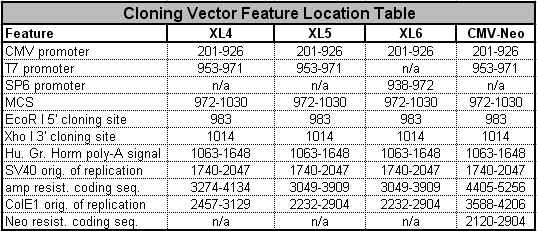
Key Functional Features of pCMV6-XL4, XL5 & XL6 vectors:
- Vector size: 4.7kb
- Selection marker in E. coli: Ampicillin-resistance
- Selection marker in mammalian cells: None. For transient transfection only
- Promoter for in vivo expression in mammalian cells: CMV promoter
- Promoter for in vitro cell free system: T7 (for pCMV6-XL4 and pCMV6-XL5) and SP6 for (pCMV6-XL6)
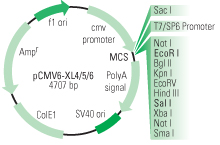
- Cloning sites: EcoRI and SalI. While EcoRI is still preserved, SalI is destroyed upon cloning.
- Restriction sites for removing insert: NotI. *Two NotI sites are flanking the cloning sites in the vector.
- Cell line suitable for transfection: COS, 293, Hela, CHO, NIH3T3, Mouse L cell, etc.
- Transcription termination and polyadenylation signals: from human growth hormone (hGH) gene.
Extensive work has been done to engineer the vector to achieve high level of transgene expression level. When compared with another popular expression plasmid, pCDNA3.1 (Invitrogen), pCMV-based plasmids provide comparable if not higher level transgene expression.
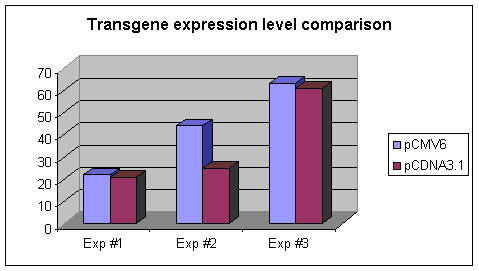
Fig 1. Comparison of transgene expression level in pCMV6- and pCDNA3.1-based plasmids. CAT gene was cloned downstream of the promoters in the pCMV6 and pCDNA3.1 vectors. In three independent experiments, a same quantity of plasmid DNA was transfected into COS1 cell and the CAT activity was scored.
References:
Cloning,
structure and expression of the mitochondrial cytochrome P-450 sterol 26-hydroxylase, a bile acid biosynthetic
enzyme. J Biol Chem. 1989 May 15; 264(14): 8222-9. Andersson S, Davis DL, Dahlback H, Jornvall H, Russell
DW.
Expression cloning and regulation of steroid 5 alpha-reductase, an enzyme essential for male sexual differentiation. J Biol Chem. 1989 Sep 25;264(27):16249-55. Andersson S, Bishop RW, Russell DW