



 Germany
 Japan
Japan
 United Kingdom
 China
China
Expression-Ready cDNA Clones
Award-winning cDNA Clones for Your Research
You have come to the right place for your cDNA clone needs! With over 25 years of experience, OriGene has accelerated gene function discovery with over 1 million cDNA clones. Our collection has been recognized not only for its broad coverage but more importantly, its high quality. In addition, lentiviral plasmid and particles are offered for difficult to transfect cells.
» Search For Your cDNA Clone (browse all)


Why Should I Use OriGene Clones?
- Comprehensive Coverage: Human / Mouse / Rat / Virus
- Multiple Expression Systems Available: Mammalian, Bacterial, Lentiviral, AAV
- Transfection-ready DNA: 10 ug provided
- Flexible Shuttling: Over 100 expression vectors
- Custom Cloning: Click here to learn more
- Proven to work: OriGene's clones have been successfully cited in Nature, Cell, and more! (view citations)
TrueClone®

Untagged cDNA clones
TrueORF®
Tagged ORF clones (Myc-DDK or GFP tag)
TrueORF® Gold
Expression-validated and sequence-verified ORF clones
Viral ORF Clones
ORF clones for viral protein expression (Myc-DDK tag)
LentiORF®
Lentiviral ORF clones
3' UTR Reporter Clones
For miRNA target validation
Mutant ORF Plasmids
Disease mutants
CDNA Clone Sets
Optimal pathway screening
Organelle Markers
Organelle Marker Plasmids
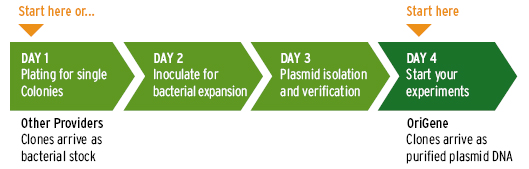
OriGene’s Expression Clones Save Times and Efforts
Customer Reviews 
Recent Citations using our Clones
|
1. Optimization of a Glucagon-Like Peptide 1 Receptor Antagonist Antibody for Treatment of Hyperinsulinism Published in Diabetes, 2023 Sep, using RG210811 |
PubMed: 37358194 |
|
2. The ubiquitin-like modifier FAT10 covalently modifies HUWE1 and strengthens the interaction of AMBRA1 and HUWE1 Published in PLOS ONE, 2023 Aug, using RC206255 |
PubMed: 37578983 |
|
3. Uncharacterized protein C17orf80 – a novel interactor of human mitochondrial nucleoids Published in Journal of Cell Science, 2023 Aug, using RC200157 |
PubMed: 37401363 |