



 Germany
 Japan
Japan
 United Kingdom
 China
China
First-strand cDNA Synthesis for Quantitative RT-PCR
OriGene’s First-strand cDNA Synthesis System for Quantitative RT-PCR has been designed for the highest efficiency conversion of RNA to cDNA and is fully optimized for quantitative real-time PCR applications.
Advantages:
- Pre-mixed format simplifies sample assembly
- Near 100% cDNA conversion from the patent-pending formulation
- High sensitivity and high reproducibility for quantitative RT-PCR (Learn more)
Order First Strand cDNA Synthesis Kit
| Catalog No. | Description | Size | Data Sheet |
|---|---|---|---|
| NP100041 | First Strand cDNA Synthesis Kit (11801-025) | 25 rxns | |
| NP100042 | First Strand cDNA Synthesis Kit (11801-100) | 100 rxns |
Technology
The specially formulated reaction buffer contains oligo dT and random hexamers and provides unbiased representation and equivalent cDNA abundance over a wide range of input RNA. The high efficiency conversion provides maximum sensitivity for quantification of low abundance RNAs and single-cell expression profiling. The patent-pending formulation captures both 3'-end and 5'-end cDNA sequence and comes in a convenient pre-mixed format that simplifies reaction assembly and generates improved precision and reproducibility in RT-PCR applications. The table below demonstrates the ease of set-up compared to the leading competitor.
OriGene's Reaction Set-up:
To a 0.2 ml tube sitting on ice add:
- x μL RNA (10picograms - 1 μg)
- 15-x μL Nuclease-free distilled water
- 4 μ 5X cDNA Master Mix
- 1 μL Reverse Transcriptase
- 20.0 μL final volume
Competitor's Set-up:
To a 0.2 ml tube sitting on ice add:
- 0.5 μL oligo(dT) 12-18, 500 ng/uL
- 0.5 μL random hexamers, 50 ng/uL
- x μ RNA (up to 1 ug)
- 2 μ 10X buffer
- 4 μ 25 mM MgCl2
- lμ 1 μ 10 mM dNTP 2 0.1M Dithiothreitol
- 1 μ RNAse H (40 u/ul)
- 1 μ Reverse Transcriptase(50 u/ul)
- 8-x μ DEPC-treated water
- 20.0 μ final volume
Performance Characteristics
Figure 1 demonstrates the high efficiency of cDNA Synthesis. In this experiment, RNA transcripts and cDNA
standards were serially diluted and the RNA was then converted to cDNA with the OriGene First-strand cDNA
Synthesis System for Quantitative RT-PCR. Comparison of the amplified RNA and the cDNA standard curve
demonstrates the high transcription efficiency achieved with the OriGene First-strand cDNA Synthesis
System.
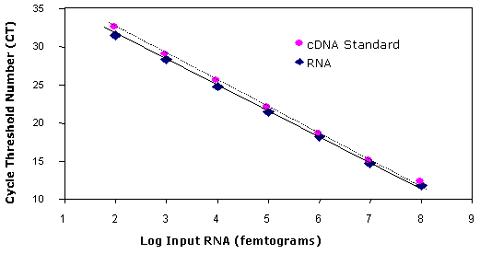
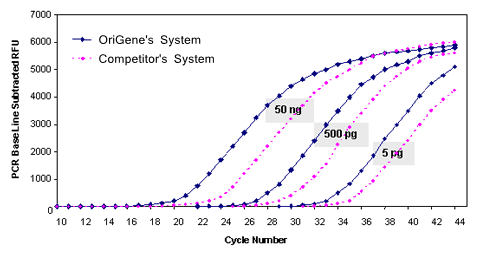
Figure 2 shows that cDNA prepared with the OriGene's First-strand cDNA Synthesis System provides
significantly enhanced sensitivity compared to cDNA prepared with a competitor's kit. In this experiment,
cDNAs prepared using each method were amplified in real time with primers specific for the 5' end of the
ADAR gene using three different levels of input RNA. At all three levels of input RNA, cDNA prepared using
OriGene’s kit has increased sensitivity in Quantitative RT-PCR.
Quality Testing
For quality testing of these products, first-strand cDNA synthesis is performed on 10-fold serial dilutions
from 1 picogram to 1 milligram of total RNA from HeLa S3 cells. One-tenth of each first strand reaction is
used as template for SYBR Green real-time PCR of beta-actin mRNA in duplicate reactions. Linearity,
sensitivity, and dynamic range are verified by Ct standard curve analysis. All solutions are verified to be
nuclease-free.