



 Germany
 Japan
Japan
 United Kingdom
 China
China
DAP3 (NM_033657) Human Mass Spec Standard
CAT#: PH323182
DAP3 MS Standard C13 and N15-labeled recombinant protein (NP_387506)
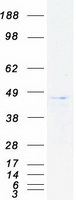
Product Images
Specifications
| Product Data | |
| Tag | C-Myc/DDK |
| Species | Human |
| Expression Host | HEK293 |
| Expression cDNA Clone or AA Sequence | RC223182 |
| Predicted MW | 45.4 kDa |
| Protein Sequence |
>RC223182 representing NM_033657
Red=Cloning site Green=Tags(s) MMLKGITRLISRIHKLDPGRFLHMGTQARQSIAAHLDNQVPVESPRAISRTNENDPAKHGDQHEGQHYNI SPQDLETVFPHGLPPRFVMQVKTFSEACLMVRKPALELLHYLKNTSFAYPAIRYLLYGEKGTGKTLSLCH VIHFCAKQDWLILHIPDAHLWVKNCRDLLQSSYNKQRFDQPLEASTWLKNFKTTNERFLNQIKVQEKYVW NKRESTEKGSPLGEVVEQGITRVRNATDAVGIVLKELKRQSSLGMFHLLVAVDGINALWGRTTLKREDKS PIAPEELALVHNLRKMMKNDWHGGAIVSALSQTGSLFKPRKAYLPQELLGKEGFDALDPFIPILVSNYNP KEFESCIQYYLENNWLQHEKAPTEEGKKELLFLSNANPSLLERHCAYL TRTRPLEQKLISEEDLAANDILDYKDDDDKV |
| Purity | > 80% as determined by SDS-PAGE and Coomassie blue staining |
| Concentration | >0.05 µg/µL as determined by microplate BCA method |
| Labeling Method | Labeled with [U- 13C6, 15N4]-L-Arginine and [U- 13C6, 15N2]-L-Lysine |
| Buffer | 25 mM Tris-HCl, 100 mM glycine, pH 7.3 |
| Storage | Store at -80°C. Avoid repeated freeze-thaw cycles. |
| Stability | Stable for 3 months from receipt of products under proper storage and handling conditions. |
| Reference Data | |
| RefSeq | NP_387506 |
| RefSeq Size | 1650 |
| RefSeq ORF | 1194 |
| Synonyms | bMRP-10; DAP-3; MRP-S29; MRPS29; S29mt |
| Locus ID | 7818 |
| UniProt ID | P51398 |
| Cytogenetics | 1q22 |
| Summary | Mammalian mitochondrial ribosomal proteins are encoded by nuclear genes and help in protein synthesis within the mitochondrion. Mitochondrial ribosomes (mitoribosomes) consist of a small 28S subunit and a large 39S subunit. They have an estimated 75% protein to rRNA composition compared to prokaryotic ribosomes, where this ratio is reversed. Another difference between mammalian mitoribosomes and prokaryotic ribosomes is that the latter contain a 5S rRNA. Among different species, the proteins comprising the mitoribosome differ greatly in sequence, and sometimes in biochemical properties, which prevents easy recognition by sequence homology. This gene encodes a 28S subunit protein that also participates in apoptotic pathways which are initiated by tumor necrosis factor-alpha, Fas ligand, and gamma interferon. This protein potentially binds ATP/GTP and might be a functional partner of the mitoribosomal protein S27. Multiple alternatively spliced transcript variants encoding distinct isoforms have been found for this gene. Pseudogenes corresponding to this gene are found on chromosomes 1q and 2q. [provided by RefSeq, Dec 2010] |
| Protein Families | Druggable Genome |
Documents
| FAQs |
| SDS |
Resources
Recombinant Protein Resources |
Other Versions
| SKU | Description | Size | Price |
|---|---|---|---|
| LC403256 | DAP3 HEK293T cell transient overexpression lysate (as WB positive control) |
USD 134.00 |
|
| LC417860 | DAP3 HEK293T cell transient overexpression lysate (as WB positive control) |
USD 134.00 |
|
| LY403256 | Transient overexpression lysate of death associated protein 3 (DAP3), nuclear gene encoding mitochondrial protein, transcript variant 1 |
USD 436.00 |
|
| LY417860 | Transient overexpression lysate of death associated protein 3 (DAP3), nuclear gene encoding mitochondrial protein, transcript variant 2 |
USD 436.00 |
|
| TP323182 | Recombinant protein of human death associated protein 3 (DAP3), nuclear gene encoding mitochondrial protein, transcript variant 1, 20 µg |
USD 867.00 |
{0} Product Review(s)
Be the first one to submit a review