



 Germany
 Japan
Japan
 United Kingdom
 China
China
Factor X (F10) (NM_000504) Human Mass Spec Standard
CAT#: PH308506
F10 MS Standard C13 and N15-labeled recombinant protein (NP_000495)
Product Images
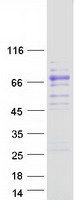
Specifications
| Product Data | |
| Tag | C-Myc/DDK |
| Species | Human |
| Expression Host | HEK293 |
| Expression cDNA Clone or AA Sequence | RC208506 |
| Predicted MW | 54.7 kDa |
| Protein Sequence |
>RC208506 protein sequence
Red=Cloning site Green=Tags(s) MGRPLHLVLLSASLAGLLLLGESLFIRREQANNILARVTRANSFLEEMKKGHLERECMEETCSYEEAREV FEDSDKTNEFWNKYKDGDQCETSPCQNQGKCKDGLGEYTCTCLEGFEGKNCELFTRKLCSLDNGDCDQFC HEEQNSVVCSCARGYTLADNGKACIPTGPYPCGKQTLERRKRSVAQATSSSGEAPDSITWKPYDAADLDP TENPFDLLDFNQTQPERGDNNLTRIVGGQECKDGECPWQALLINEENEGFCGGTILSEFYILTAAHCLYQ AKRFKVRVGDRNTEQEEGGEAVHEVEVVIKHNRFTKETYDFDIAVLRLKTPITFRMNVAPACLPERDWAE STLMTQKTGIVSGFGRTHEKGRQSTRLKMLEVPYVDRNSCKLSSSFIITQNMFCAGYDTKQEDACQGDSG GPHVTRFKDTYFVTGIVSWGEGCARKGKYGIYTKVTAFLKWIDRSMKTRGLPKAKSHAPEVITSSPLK TRTRPLEQKLISEEDLAANDILDYKDDDDKV |
| Purity | > 80% as determined by SDS-PAGE and Coomassie blue staining |
| Concentration | >0.05 µg/µL as determined by microplate BCA method |
| Labeling Method | Labeled with [U- 13C6, 15N4]-L-Arginine and [U- 13C6, 15N2]-L-Lysine |
| Buffer | 25 mM Tris-HCl, 100 mM glycine, pH 7.3 |
| Storage | Store at -80°C. Avoid repeated freeze-thaw cycles. |
| Stability | Stable for 3 months from receipt of products under proper storage and handling conditions. |
| Reference Data | |
| RefSeq | NP_000495 |
| RefSeq Size | 1560 |
| RefSeq ORF | 1464 |
| Synonyms | FX; FXA |
| Locus ID | 2159 |
| UniProt ID | P00742, Q5JVE7 |
| Cytogenetics | 13q34 |
| Summary | This gene encodes the vitamin K-dependent coagulation factor X of the blood coagulation cascade. This factor undergoes multiple processing steps before its preproprotein is converted to a mature two-chain form by the excision of the tripeptide RKR. Two chains of the factor are held together by 1 or more disulfide bonds; the light chain contains 2 EGF-like domains, while the heavy chain contains the catalytic domain which is structurally homologous to those of the other hemostatic serine proteases. The mature factor is activated by the cleavage of the activation peptide by factor IXa (in the intrisic pathway), or by factor VIIa (in the extrinsic pathway). The activated factor then converts prothrombin to thrombin in the presence of factor Va, Ca+2, and phospholipid during blood clotting. Mutations of this gene result in factor X deficiency, a hemorrhagic condition of variable severity. Alternative splicing results in multiple transcript variants encoding different isoforms that may undergo similar proteolytic processing to generate mature polypeptides. [provided by RefSeq, Aug 2015] |
| Protein Families | Druggable Genome, Protease, Transmembrane |
| Protein Pathways | Complement and coagulation cascades |
Documents
| FAQs |
| SDS |
Resources
Recombinant Protein Resources |
Other Versions
| SKU | Description | Size | Price |
|---|---|---|---|
| LC400172 | F10 HEK293T cell transient overexpression lysate (as WB positive control) |
USD 134.00 |
|
| LY400172 | Transient overexpression lysate of coagulation factor X (F10) |
USD 436.00 |
|
| TP308506 | Recombinant protein of human coagulation factor X (F10), 20 µg |
USD 867.00 |
|
| TP507705 | Purified recombinant protein of Mouse coagulation factor X (F10), with C-terminal MYC/DDK tag, expressed in HEK293T cells, 20ug |
USD 988.00 |
{0} Product Review(s)
Be the first one to submit a review