



 Germany
 Japan
Japan
 United Kingdom
 China
China
Kv beta 1 (KCNAB1) (NM_172159) Human Mass Spec Standard
CAT#: PH307384
KCNAB1 MS Standard C13 and N15-labeled recombinant protein (NP_751891)
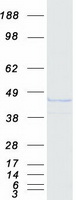
Product Images
Specifications
| Product Data | |
| Tag | C-Myc/DDK |
| Species | Human |
| Expression Host | HEK293 |
| Expression cDNA Clone or AA Sequence | RC207384 |
| Predicted MW | 44.7 kDa |
| Protein Sequence |
>RC207384 protein sequence
Red=Cloning site Green=Tags(s) MQVSIACTEHNLKSRNGEDRLLSKQSSTAPNVVNAARAKFRTVAIIARSLGTFTPQHHISLKESTAKQTG MKYRNLGKSGLRVSCLGLGTWVTFGGQISDEVAERLMTIAYESGVNLFDTAEVYAAGKAEVILGSIIKKK GWRRSSLVITTKLYWGGKAETERGLSRKHIIEGLKGSLQRLQLEYVDVVFANRPDSNTPMEEIVRAMTHV INQGMAMYWGTSRWSAMEIMEAYSVARQFNMIPPVCEQAEYHLFQREKVEVQLPELYHKIGVGAMTWSPL ACGIISGKYGNGVPESSRASLKCYQWLKERIVSEEGRKQQNKLKDLSPIAERLGCTLPQLAVAWCLRNEG VSSVLLGSSTPEQLIENLGAIQVLPKMTSHVVNEIDNILRNKPYSKKDYRS TRTRPLEQKLISEEDLAANDILDYKDDDDKV |
| Purity | > 80% as determined by SDS-PAGE and Coomassie blue staining |
| Concentration | >0.05 µg/µL as determined by microplate BCA method |
| Labeling Method | Labeled with [U- 13C6, 15N4]-L-Arginine and [U- 13C6, 15N2]-L-Lysine |
| Buffer | 25 mM Tris-HCl, 100 mM glycine, pH 7.3 |
| Storage | Store at -80°C. Avoid repeated freeze-thaw cycles. |
| Stability | Stable for 3 months from receipt of products under proper storage and handling conditions. |
| Reference Data | |
| RefSeq | NP_751891 |
| RefSeq Size | 4518 |
| RefSeq ORF | 1203 |
| Synonyms | AKR6A3; hKvb3; hKvBeta3; KCNA1B; KV-BETA-1; Kvb1.3 |
| Locus ID | 7881 |
| UniProt ID | Q14722 |
| Cytogenetics | 3q25.31 |
| Summary | Potassium channels represent the most complex class of voltage-gated ion channels from both functional and structural standpoints. Their diverse functions include regulating neurotransmitter release, heart rate, insulin secretion, neuronal excitability, epithelial electrolyte transport, smooth muscle contraction, and cell volume. Four sequence-related potassium channel genes - shaker, shaw, shab, and shal - have been identified in Drosophila, and each has been shown to have human homolog(s). This gene encodes a member of the potassium channel, voltage-gated, shaker-related subfamily. This member includes distinct isoforms which are encoded by alternatively spliced transcript variants of this gene. Some of these isoforms are beta subunits, which form heteromultimeric complexes with alpha subunits and modulate the activity of the pore-forming alpha subunits. [provided by RefSeq, Apr 2015] |
| Protein Families | Druggable Genome, Ion Channels: Other |
Documents
| FAQs |
| SDS |
Resources
Recombinant Protein Resources |
Other Versions
| SKU | Description | Size | Price |
|---|---|---|---|
| LC403531 | KCNAB1 HEK293T cell transient overexpression lysate (as WB positive control) |
USD 134.00 |
|
| LC406773 | KCNAB1 HEK293T cell transient overexpression lysate (as WB positive control) |
USD 206.00 |
|
| LC418655 | KCNAB1 HEK293T cell transient overexpression lysate (as WB positive control) |
USD 134.00 |
|
| LC429147 | KCNAB1 HEK293T cell transient overexpression lysate (as WB positive control) |
USD 134.00 |
|
| LC430344 | KCNAB1 HEK293T cell transient overexpression lysate (as WB positive control) |
USD 134.00 |
|
| LY403531 | Transient overexpression lysate of potassium voltage-gated channel, shaker-related subfamily, beta member 1 (KCNAB1), transcript variant 3 |
USD 436.00 |
|
| LY406773 | Transient overexpression lysate of potassium voltage-gated channel, shaker-related subfamily, beta member 1 (KCNAB1), transcript variant 1 |
USD 665.00 |
|
| LY418655 | Transient overexpression lysate of potassium voltage-gated channel, shaker-related subfamily, beta member 1 (KCNAB1), transcript variant 2 |
USD 436.00 |
|
| LY430344 | Transient overexpression lysate of potassium voltage-gated channel, shaker-related subfamily, beta member 1 (KCNAB1), transcript variant 1 |
USD 436.00 |
|
| TP307384 | Recombinant protein of human potassium voltage-gated channel, shaker-related subfamily, beta member 1 (KCNAB1), transcript variant 3, 20 µg |
USD 867.00 |
{0} Product Review(s)
Be the first one to submit a review