



 Germany
 Japan
Japan
 United Kingdom
 China
China
S100 beta (S100B) (NM_006272) Human Mass Spec Standard
CAT#: PH300277
S100B MS Standard C13 and N15-labeled recombinant protein (NP_006263)
Product Images
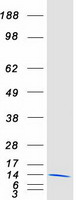
Specifications
| Product Data | |
| Tag | C-Myc/DDK |
| Species | Human |
| Expression Host | HEK293 |
| Expression cDNA Clone or AA Sequence | RC200277 |
| Predicted MW | 10.7 kDa |
| Protein Sequence |
>RC200277 protein sequence
Red=Cloning site Green=Tags(s) MSELEKAMVALIDVFHQYSGREGDKHKLKKSELKELINNELSHFLEEIKEQEVVDKVMETLDNDGDGECD FQEFMAFVAMVTTACHEFFEHE TRTRPLEQKLISEEDLAANDILDYKDDDDKV |
| Purity | > 80% as determined by SDS-PAGE and Coomassie blue staining |
| Concentration | >0.05 µg/µL as determined by microplate BCA method |
| Labeling Method | Labeled with [U- 13C6, 15N4]-L-Arginine and [U- 13C6, 15N2]-L-Lysine |
| Buffer | 25 mM Tris-HCl, 100 mM glycine, pH 7.3 |
| Storage | Store at -80°C. Avoid repeated freeze-thaw cycles. |
| Stability | Stable for 3 months from receipt of products under proper storage and handling conditions. |
| Reference Data | |
| RefSeq | NP_006263 |
| RefSeq Size | 1135 |
| RefSeq ORF | 276 |
| Synonyms | NEF; S100; S100-B; S100beta |
| Locus ID | 6285 |
| UniProt ID | P04271, A0A0S2Z4C5 |
| Cytogenetics | 21q22.3 |
| Summary | The protein encoded by this gene is a member of the S100 family of proteins containing 2 EF-hand calcium-binding motifs. S100 proteins are localized in the cytoplasm and/or nucleus of a wide range of cells, and involved in the regulation of a number of cellular processes such as cell cycle progression and differentiation. S100 genes include at least 13 members which are located as a cluster on chromosome 1q21; however, this gene is located at 21q22.3. This protein may function in Neurite extension, proliferation of melanoma cells, stimulation of Ca2+ fluxes, inhibition of PKC-mediated phosphorylation, astrocytosis and axonal proliferation, and inhibition of microtubule assembly. Chromosomal rearrangements and altered expression of this gene have been implicated in several neurological, neoplastic, and other types of diseases, including Alzheimer's disease, Down's syndrome, epilepsy, amyotrophic lateral sclerosis, melanoma, and type I diabetes. [provided by RefSeq, Jul 2008] |
Documents
| FAQs |
| SDS |
Resources
Recombinant Protein Resources |
Other Versions
| SKU | Description | Size | Price |
|---|---|---|---|
| LC416735 | S100B HEK293T cell transient overexpression lysate (as WB positive control) |
USD 134.00 |
|
| LY416735 | Transient overexpression lysate of S100 calcium binding protein B (S100B) |
USD 436.00 |
|
| TP300277 | Recombinant protein of human S100 calcium binding protein B (S100B), 20 µg |
USD 867.00 |
|
| TP750189 | Purified recombinant protein of Human S100 calcium binding protein B (S100B),full length, tag free, expressed in E.coli, 50ug |
USD 362.00 |
{0} Product Review(s)
Be the first one to submit a review