



 Germany
 Japan
Japan
 United Kingdom
 China
China
LAMC2 (NM_005562) Human Mass Spec Standard
CAT#: PH322076
LAMC2 MS Standard C13 and N15-labeled recombinant protein (NP_005553)
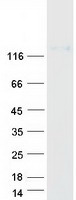
Product Images
Specifications
| Product Data | |
| Tag | C-Myc/DDK |
| Species | Human |
| Expression Host | HEK293 |
| Expression cDNA Clone or AA Sequence | RC222076 |
| Predicted MW | 130.99 kDa |
| Protein Sequence |
>RC222076 representing NM_005562
Red=Cloning site Green=Tags(s) MPALWLGCCLCFSLLLPAARATSRREVCDCNGKSRQCIFDRELHRQTGNGFRCLNCNDNTDGIHCEKCKN GFYRHRERDRCLPCNCNSKGSLSARCDNSGRCSCKPGVTGARCDRCLPGFHMLTDAGCTQDQRLLDSKCD CDPAGIAGPCDAGRCVCKPAVTGERCDRCRSGYYNLDGGNPEGCTQCFCYGHSASCRSSAEYSVHKITST FHQDVDGWKAVQRNGSPAKLQWSQRHQDVFSSAQRLDPVYFVAPAKFLGNQQVSYGQSLSFDYRVDRGGR HPSAHDVILEGAGLRITAPLMPLGKTLPCGLTKTYTFRLNEHPSNNWSPQLSYFEYRRLLRNLTALRIRA TYGEYSTGYIDNVTLISARPVSGAPAPWVEQCICPVGYKGQFCQDCASGYKRDSARLGPFGTCIPCNCQG GGACDPDTGDCYSGDENPDIECADCPIGFYNDPHDPRSCKPCPCHNGFSCSVMPETEEVVCNNCPPGVTG ARCELCADGYFGDPFGEHGPVRPCQPCQCNNNVDPSASGNCDRLTGRCLKCIHNTAGIYCDQCKAGYFGD PLAPNPADKCRACNCNPMGSEPVGCRSDGTCVCKPGFGGPNCEHGAFSCPACYNQVKIQMDQFMQQLQRM EALISKAQGGDGVVPDTELEGRMQQAEQALQDILRDAQISEGASRSLGLQLAKVRSQENSYQSRLDDLKM TVERVRALGSQYQNRVRDTHRLITQMQLSLAESEASLGNTNIPASDHYVGPNGFKSLAQEATRLAESHVE SASNMEQLTRETEDYSKQALSLVRKALHEGVGSGSGSPDGAVVQGLVEKLEKTKSLAQQLTREATQAEIE ADRSYQHSLRLLDSVSRLQGVSDQSFQVEEAKRIKQKADSLSTLVTRHMDEFKRTQKNLGNWKEEAQQLL QNGKSGREKSDQLLSRANLAKSRAQEALSMGNATFYEVESILKNLREFDLQVDNRKAEAEEAMKRLSYIS QKVSDASDKTQQAERALGSAAADAQRAKNGAGEALEISSEIEQEIGSLNLEANVTADGALAMEKGLASLK SEMREVEGELERKELEFDTNMDAVQMVITEAQKVDTRAKNAGVTIQDTLNTLDGLLHLMDQPLSVDEEGL VLLEQKLSRAKTQINSQLRPMMSELEERARQQRGHLHLLETSIDGILADVKNLENIRDNLPPGCYNTQAL EQQ TRTRPLEQKLISEEDLAANDILDYKDDDDKV |
| Purity | > 80% as determined by SDS-PAGE and Coomassie blue staining |
| Concentration | >0.05 µg/µL as determined by microplate BCA method |
| Labeling Method | Labeled with [U- 13C6, 15N4]-L-Arginine and [U- 13C6, 15N2]-L-Lysine |
| Buffer | 25 mM Tris-HCl, 100 mM glycine, pH 7.3 |
| Storage | Store at -80°C. Avoid repeated freeze-thaw cycles. |
| Stability | Stable for 3 months from receipt of products under proper storage and handling conditions. |
| Reference Data | |
| RefSeq | NP_005553 |
| RefSeq Size | 5175 |
| RefSeq ORF | 3579 |
| Synonyms | B2T; BM600; CSF; EBR2; EBR2A; LAMB2T; LAMNB2 |
| Locus ID | 3918 |
| UniProt ID | Q13753 |
| Cytogenetics | 1q25.3 |
| Summary | Laminins, a family of extracellular matrix glycoproteins, are the major noncollagenous constituent of basement membranes. They have been implicated in a wide variety of biological processes including cell adhesion, differentiation, migration, signaling, neurite outgrowth and metastasis. Laminins, composed of 3 non identical chains: laminin alpha, beta and gamma (formerly A, B1, and B2, respectively), have a cruciform structure consisting of 3 short arms, each formed by a different chain, and a long arm composed of all 3 chains. Each laminin chain is a multidomain protein encoded by a distinct gene. Several isoforms of each chain have been described. Different alpha, beta and gamma chain isomers combine to give rise to different heterotrimeric laminin isoforms which are designated by Arabic numerals in the order of their discovery, i.e. alpha1beta1gamma1 heterotrimer is laminin 1. The biological functions of the different chains and trimer molecules are largely unknown, but some of the chains have been shown to differ with respect to their tissue distribution, presumably reflecting diverse functions in vivo. This gene encodes the gamma chain isoform laminin, gamma 2. The gamma 2 chain, formerly thought to be a truncated version of beta chain (B2t), is highly homologous to the gamma 1 chain; however, it lacks domain VI, and domains V, IV and III are shorter. It is expressed in several fetal tissues but differently from gamma 1, and is specifically localized to epithelial cells in skin, lung and kidney. The gamma 2 chain together with alpha 3 and beta 3 chains constitute laminin 5 (earlier known as kalinin), which is an integral part of the anchoring filaments that connect epithelial cells to the underlying basement membrane. The epithelium-specific expression of the gamma 2 chain implied its role as an epithelium attachment molecule, and mutations in this gene have been associated with junctional epidermolysis bullosa, a skin disease characterized by blisters due to disruption of the epidermal-dermal junction. Two transcript variants resulting from alternative splicing of the 3' terminal exon, and encoding different isoforms of gamma 2 chain, have been described. The two variants are differentially expressed in embryonic tissues, however, the biological significance of the two forms is not known. Transcript variants utilizing alternative polyA_signal have also been noted in literature. [provided by RefSeq, Aug 2011] |
| Protein Families | Druggable Genome, Secreted Protein |
| Protein Pathways | ECM-receptor interaction, Focal adhesion, Pathways in cancer, Small cell lung cancer |
Documents
| FAQs |
| SDS |
Resources
Recombinant Protein Resources |
Other Versions
| SKU | Description | Size | Price |
|---|---|---|---|
| LC412907 | LAMC2 HEK293T cell transient overexpression lysate (as WB positive control) |
USD 206.00 |
|
| LC417224 | LAMC2 HEK293T cell transient overexpression lysate (as WB positive control) |
USD 206.00 |
|
| LC429255 | LAMC2 HEK293T cell transient overexpression lysate (as WB positive control) |
USD 206.00 |
|
| LY412907 | Transient overexpression lysate of laminin, gamma 2 (LAMC2), transcript variant 2 |
USD 665.00 |
|
| LY417224 | Transient overexpression lysate of laminin, gamma 2 (LAMC2), transcript variant 1 |
USD 665.00 |
|
| LY429255 | Transient overexpression lysate of laminin, gamma 2 (LAMC2), transcript variant 1 |
USD 665.00 |
|
| PH318516 | LAMC2 MS Standard C13 and N15-labeled recombinant protein (NP_061486) |
USD 3,255.00 |
|
| TP318516 | Recombinant protein of human laminin, gamma 2 (LAMC2), transcript variant 2, 20 µg |
USD 867.00 |
|
| TP322076 | Recombinant protein of human laminin, gamma 2 (LAMC2), transcript variant 1, 20 µg |
USD 867.00 |
|
| TP762319 | Purified recombinant protein of Human laminin, gamma 2 (LAMC2), transcript variant 1, Pro808-Leu909, with N-terminal His tag, expressed in E.coli, 50ug |
USD 249.00 |
{0} Product Review(s)
Be the first one to submit a review