



 Germany
 Japan
Japan
 United Kingdom
 China
China
HAAO (NM_012205) Human Mass Spec Standard
CAT#: PH306273
HAAO MS Standard C13 and N15-labeled recombinant protein (NP_036337)
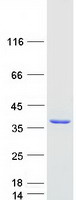
Product Images
Specifications
| Product Data | |
| Tag | C-Myc/DDK |
| Species | Human |
| Expression Host | HEK293 |
| Expression cDNA Clone or AA Sequence | RC206273 |
| Predicted MW | 32.6 kDa |
| Protein Sequence |
>RC206273 protein sequence
Red=Cloning site Green=Tags(s) MERRLGVRAWVKENRGSFQPPVCNKLMHQEQLKVMFIGGPNTRKDYHIEEGEEVFYQLEGDMVLRVLEQG KHRDVVIRQGEIFLLPARVPHSPQRFANTVGLVVERRRLETELDGLRYYVGDTMDVLFEKWFYCKDLGTQ LAPIIQEFFSSEQYRTGKPIPDQLLKEPPFPLSTRSIMEPMSLDAWLDSHHRELQAGTPLSLFGDTYETQ VIAYGQGSSEGLRQNVDVWLWQLEGSSVVTMGGRRLSLAPDDSLLVLAGTSYAWERTQGSVALSVTQDPA CKKPLG TRTRPLEQKLISEEDLAANDILDYKDDDDKV |
| Purity | > 80% as determined by SDS-PAGE and Coomassie blue staining |
| Concentration | >0.05 µg/µL as determined by microplate BCA method |
| Labeling Method | Labeled with [U- 13C6, 15N4]-L-Arginine and [U- 13C6, 15N2]-L-Lysine |
| Buffer | 25 mM Tris-HCl, 100 mM glycine, pH 7.3 |
| Storage | Store at -80°C. Avoid repeated freeze-thaw cycles. |
| Stability | Stable for 3 months from receipt of products under proper storage and handling conditions. |
| Reference Data | |
| RefSeq | NP_036337 |
| RefSeq Size | 1301 |
| RefSeq ORF | 858 |
| Synonyms | 3-HAO; h3HAO; HAO; VCRL1 |
| Locus ID | 23498 |
| UniProt ID | P46952 |
| Cytogenetics | 2p21 |
| Summary | 3-Hydroxyanthranilate 3,4-dioxygenase is a monomeric cytosolic protein belonging to the family of intramolecular dioxygenases containing nonheme ferrous iron. It is widely distributed in peripheral organs, such as liver and kidney, and is also present in low amounts in the central nervous system. HAAO catalyzes the synthesis of quinolinic acid (QUIN) from 3-hydroxyanthranilic acid. QUIN is an excitotoxin whose toxicity is mediated by its ability to activate glutamate N-methyl-D-aspartate receptors. Increased cerebral levels of QUIN may participate in the pathogenesis of neurologic and inflammatory disorders. HAAO has been suggested to play a role in disorders associated with altered tissue levels of QUIN. [provided by RefSeq, Jul 2008] |
| Protein Pathways | Metabolic pathways, Tryptophan metabolism |
Documents
| FAQs |
| SDS |
Resources
Recombinant Protein Resources |
Other Versions
| SKU | Description | Size | Price |
|---|---|---|---|
| LC415914 | HAAO HEK293T cell transient overexpression lysate (as WB positive control) |
USD 134.00 |
|
| LY415914 | Transient overexpression lysate of 3-hydroxyanthranilate 3,4-dioxygenase (HAAO) |
USD 436.00 |
|
| TP306273 | Recombinant protein of human 3-hydroxyanthranilate 3,4-dioxygenase (HAAO), 20 µg |
USD 867.00 |
{0} Product Review(s)
Be the first one to submit a review